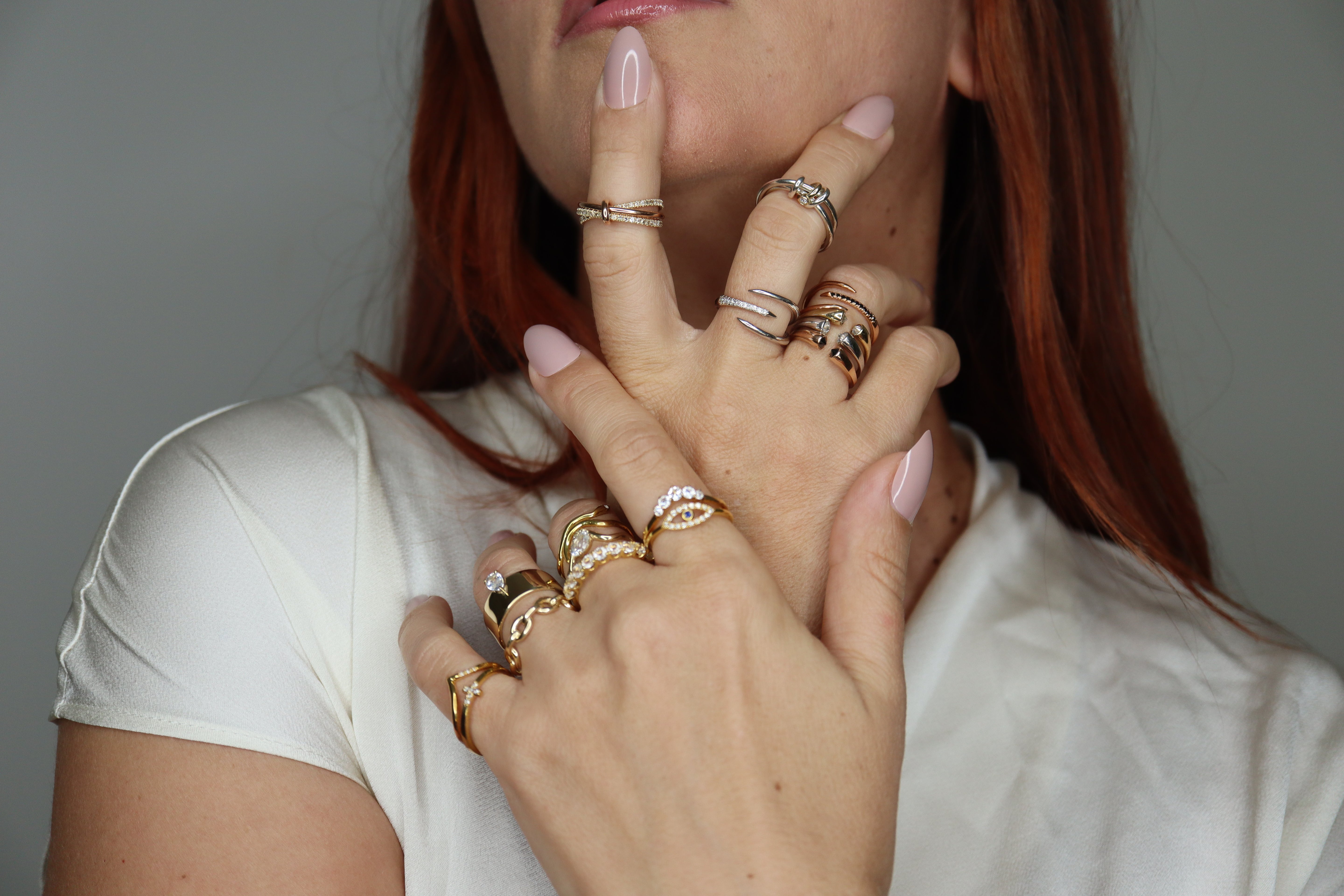





Gold Fidget Rings vs. Cheap Anxiety Rings: Why Material Matters
Why Material Matters When Choosing Between Gold Fidget Rings and Cheap Anxiety Rings
The reason material matters when comparing gold fidget rings to cheap anxiety rings is that the difference between them goes far beyond price. A search for "fidget ring" or "anxiety ring" returns hundreds of results under $20 - stainless steel spinners, plated brass bands with rotating outer rings, titanium bands with bead tracks. They spin. They move. They serve a purpose for a few weeks or months before the plating peels, the movement gets gritty, or the novelty wears thin enough that the ring ends up in a drawer.
A kinetic ring in solid 14k gold occupies entirely different territory. It is fine jewelry that provides tactile and sensory benefits as an inherent feature of its construction - not a disposable tool built for a single function. The material, the movement quality, the craftsmanship, and the longevity are in different categories entirely. This guide breaks down the differences so you can make an informed decision about what belongs on your finger.
What Materials Are Used in Cheap Fidget Rings vs. Gold Kinetic Rings?
Mass-market fidget rings are typically made from one of three materials: stainless steel, plated brass, or titanium. Each has limitations that become apparent within weeks to months of continuous wear.
Stainless steel is durable and affordable but heavy in the wrong way - it carries a cold, industrial weight rather than the warm density of gold. It does not conduct heat efficiently, so it stays cool against your skin regardless of how long you wear it. Some stainless steel alloys contain nickel, which triggers skin reactions in a significant percentage of wearers. The surface finish dulls over time and cannot be easily restored to its original appearance.
Plated brass is the material behind most sub-$15 fidget rings. A thin layer of gold, silver, or rhodium coating over a base metal core. The plating wears through at friction points - and in a ring designed to move, every surface is a friction point. Within weeks of regular wear, the plating at the spinning contact area begins to reveal the brass beneath. The ring turns green on your finger. The movement degrades as the smooth plated surface gives way to the rougher base metal.
Titanium is lightweight and hypoallergenic but cannot be resized, repaired, or polished by most jewelers. It also lacks the density that makes precious metals feel substantial on the finger. A titanium fidget ring feels airy - almost disposable - compared to solid gold.
Solid 14k gold eliminates every one of these problems. The alloy (58.3% gold, balance copper, silver, zinc) conducts heat immediately, matching your body temperature within minutes. It contains no nickel. It will not tarnish, corrode, or change color regardless of exposure to water, sweat, soap, or chemicals. The surface can be polished back to mirror-finish at any point by any jeweler. And it carries a warm, grounding weight that lighter metals simply cannot provide.
How Does Movement Quality Differ Between Spinner Rings and Kinetic Rings?
The movement in a mass-market spinner ring is a byproduct of loose tolerances. The outer band spins because the gap between the inner and outer rings is wide enough to allow free rotation. This approach is cheap to manufacture - stamp two concentric bands, leave a gap, done. The movement is functional but one-dimensional: spin and stop. There is no variation, no complexity, and no evolution in the interaction over time. After a few hundred spins, your brain has fully mapped the experience and stops finding it engaging.
Kinetic rings from Antoanetta achieve movement through precision assembly rather than loose construction. Articulated links on the Alizée slide along a calibrated channel with tolerances measured in fractions of a millimeter. Each link can fan, cluster, spread, rotate, and rest in dozens of configurations. The movement is multi-directional and infinitely variable - no two interactions produce exactly the same result. Rolling bands on the Aria orbit through a connector bridge that allows full rotation while maintaining concentricity. The motion is fluid and organic, not mechanical.
This difference in movement quality directly affects how long the ring remains engaging. A single-axis spinner exhausts its novelty quickly. A multi-axis kinetic ring with seven independently moving links offers enough variation to remain interesting indefinitely. The tactile benefit does not diminish because the experience keeps evolving.
How Long Do Cheap Fidget Rings Last Compared to Gold Kinetic Rings?
A plated fidget ring has a functional lifespan measured in weeks to months. The plating wears through at the spinning contact point first, then progressively across the entire band. The movement degrades as exposed base metal creates friction. The ring becomes uncomfortable as nickel in the brass core contacts skin. At this point, the ring is disposable - it cannot be repaired, replated, or restored to usable condition.
A solid 14k gold kinetic ring has a functional lifespan measured in decades - potentially generations. The material does not degrade. The movement does not change. The color does not fade. Twenty years of daily wear produces the same ring you received on day one, plus whatever patina or surface character has developed from living on your hand. Minor scratches from daily use can be polished out by any jeweler at any point. Gemstone settings can be tightened if needed. The ring remains fully functional and beautiful indefinitely.
When you calculate cost over time, the math inverts. A $15 plated spinner ring replaced every three months costs $60 per year - $600 over ten years - with nothing to show for it at the end. A solid 14k gold kinetic ring at $2,200 costs $220 per year over ten years, $110 per year over twenty years, and at the end of that period you own an asset with real gold value that can be passed to the next generation. Read the full lifetime cost analysis for a detailed breakdown.
How Does the Sensory Experience of Gold Compare to Stainless Steel?
If you are wearing a fidget ring for its sensory and grounding properties, the material's physical behavior matters as much as the movement mechanism.
Stainless steel conducts heat poorly. It feels cool on your finger for an extended period after putting it on, and it returns to room temperature quickly when removed. The tactile experience is functional but clinical - metal on skin without warmth.
Solid 14k gold conducts heat efficiently and absorbs your body temperature within minutes. Once warm, it stays warm for as long as you wear it. The moving links carry this warmth as they shift positions, creating a thermal experience alongside the tactile one. Warm gold gliding across warm skin produces a sensory quality that stainless steel - regardless of how well-engineered its movement - cannot replicate.
Weight plays a role too. Gold's density (approximately 12.9 g/cm³ for the 14k alloy) versus stainless steel (approximately 8 g/cm³) means a gold kinetic ring of the same dimensions weighs roughly 60% more. This additional weight translates to a more grounding, more substantial sensation on the finger - the kind of gentle, constant pressure that weighted sensory tools use to promote calm.
How Do Gold Kinetic Rings and Cheap Fidget Rings Differ in Social Context?
There is a social dimension to consider. A visible stainless steel spinner ring with an obvious spinning mechanism signals a specific thing - it reads as a fidget tool. In casual contexts, this is perfectly fine. In professional settings, formal occasions, or situations where you prefer discretion, the signal may not be what you want to send.
A kinetic ring in solid 14k gold with diamond or gemstone accents reads as fine jewelry. The movement is there - and anyone watching closely might notice the links shifting or the bands rotating - but the primary impression is one of quality, taste, and refinement. The tactile benefit is invisible to everyone except you. You can interact with a Vortexa during a board meeting and no one will identify what you are doing. They will see a striking piece of jewelry. The grounding is your private experience.
What Are the Most Affordable Gold Kinetic Rings?
One valid concern about gold kinetic rings is the price point. Not everyone is ready to invest $2,000+ in a ring, especially if they are trying kinetic jewelry for the first time. Antoanetta offers entry points that make the transition from mass-market fidget rings to solid gold more accessible.
The Eclisse at $250 provides the solid 14k gold construction and kinetic movement at the lowest price point in the collection. The Harmony at $400 offers a more developed kinetic design while remaining significantly more affordable than the signature pieces. Both are genuine solid gold moving rings - not compromises or stripped-down versions - that let you experience the material and movement quality before committing to a larger investment.
Read the beginner's guide for a step-by-step approach to choosing your first kinetic ring, including recommendations by budget range.
Frequently Asked Questions About Gold Fidget Rings vs. Cheap Anxiety Rings
Can a gold kinetic ring replace my existing anxiety ring?
Yes - it provides the same tactile interaction with significantly better movement quality, material longevity, and sensory properties. The transition is immediate; you can wear a kinetic gold ring exactly the same way you would wear a stainless steel spinner.
Are gold fidget rings too heavy for all-day wear?
No. The weight of solid gold is part of the grounding benefit. Most wearers adapt within one to three days and subsequently find lighter rings unsatisfying by comparison. Read the comfort guide for detailed information on weight adaptation.
Does the gold movement get less smooth over time?
No. Solid 14k gold maintains its surface quality indefinitely. Unlike plated rings where the smooth coating wears away to reveal rough base metal, solid gold is the same material all the way through. The movement quality does not degrade.
Are there kinetic rings under $500?
Yes. The Eclisse starts at $250 and the Harmony at $400 - both in solid 14k gold with genuine kinetic movement. Browse the kinetic rings collection to see all available designs and price points.