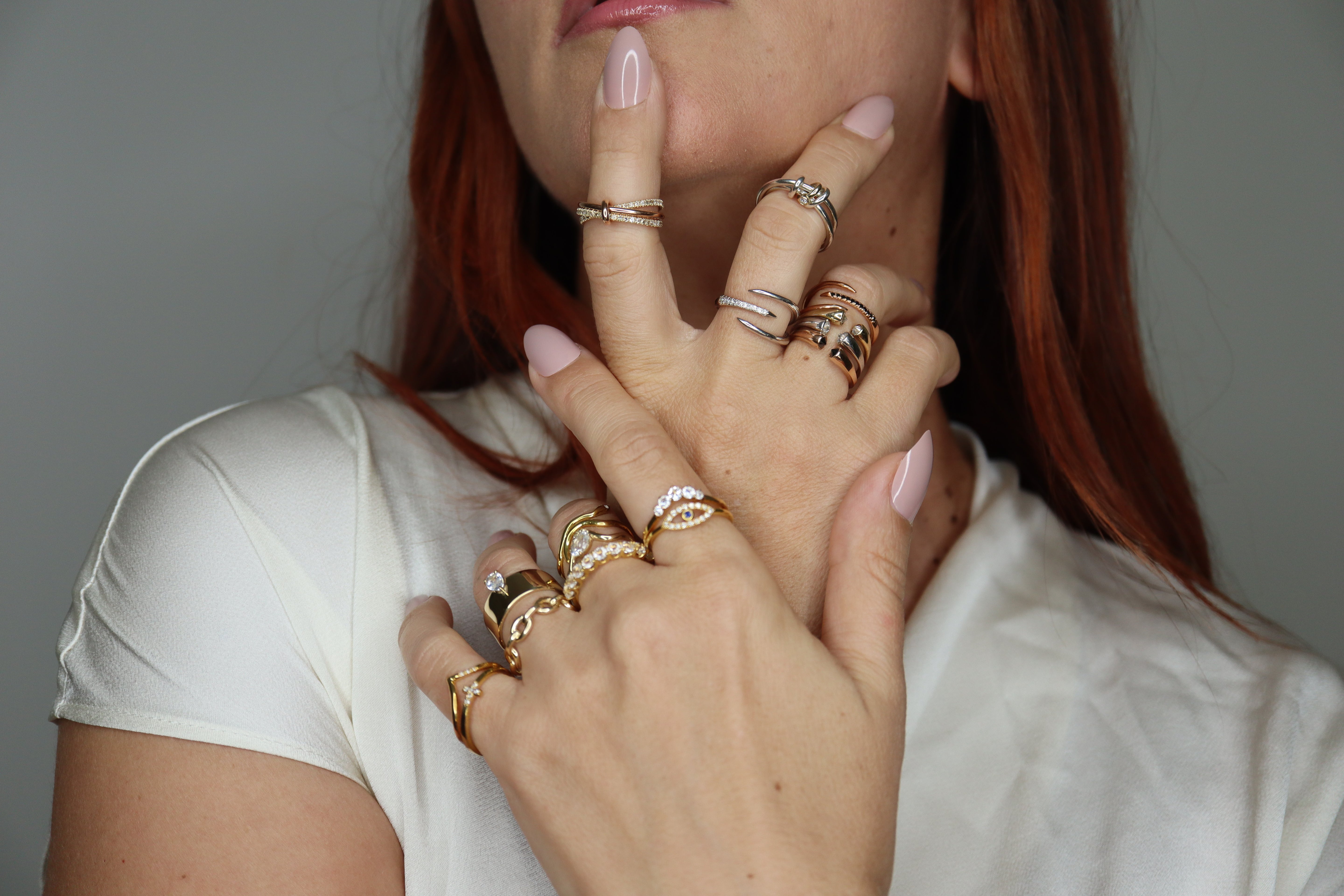





Are Kinetic Rings Comfortable for Everyday Wear?
Yes, kinetic rings are comfortable for everyday wear, and Antoanetta's kinetic rings are specifically engineered to be worn 24/7, including sleeping, showering, exercising, typing, and cooking, without ever needing to come off. The most common hesitation before buying a kinetic ring is not about the gold or the design but about comfort. Will the moving links pinch? Will the rolling bands catch on skin? Can you actually sleep in a ring that has moving parts? These are reasonable questions, and the honest answer is that every concern on that list has been addressed through deliberate engineering and hand-finished construction.
This guide covers exactly what a kinetic ring feels like on your finger across every scenario in a typical day, so you know what to expect before the ring arrives.
How Much Do Kinetic Rings Weigh?
A kinetic ring weighs more than a standard band of the same width because it is constructed from multiple solid 14k gold components. The Marque, a 6mm-wide articulated link ring, carries a noticeable heft that you feel the moment you slide it on. The Aria, with three interlocking bands plus a diamond bridge connector, has a satisfying density across a slightly narrower profile.
Most wearers describe this weight as grounding rather than cumbersome. Solid 14k gold has a density of approximately 12.9 g/cm³, heavier than stainless steel and significantly heavier than plated alternatives built on hollow brass cores. The weight settles against your finger in a way that feels permanent and intentional. After the first few hours of wear, your hand adapts to the presence and the weight becomes part of your baseline awareness - there but not intrusive.
If you have never worn a ring heavier than a thin wedding band, the adjustment period is typically one to three days. By the end of the first week, most wearers report that removing the ring feels stranger than wearing it.
Do Kinetic Rings Feel Smooth or Abrasive Against Skin?
The links on an articulated kinetic ring slide along the band while resting against the top surface of your finger. The interior surfaces where gold contacts skin are polished to a smooth finish - not the mirror-polish used on exterior display surfaces, but a satin-smooth quality that prevents any grittiness or friction against skin.
The critical engineering detail is edge finishing. Every link edge, every band edge, and every connector surface that could potentially contact skin is rounded during the hand-finishing process. There are no sharp corners. No burrs. No seams where casting mold lines were left unfinished. The bench jewelers at Antoanetta's Los Angeles atelier test movement against their own skin during assembly - if any component catches or drags, it goes back for additional finishing before the ring leaves the shop.
Rolling band designs like the Vortexa present a different contact profile. The interlocking bands rotate against your finger in a gentle orbital motion. Because the bands are curved (following the circular shape of the ring), the contact area shifts continuously - no single spot on your finger bears prolonged pressure. This distributed contact is one reason rolling bands feel particularly comfortable even during all-day wear.
Can You Sleep While Wearing a Kinetic Ring?
This is the question people think about but sometimes hesitate to ask: can you sleep in it?
Yes. Kinetic rings are designed to be worn continuously, including overnight. The links on an articulated design settle into a resting position when your hand is still - they do not randomly slide around while you sleep. Rolling bands naturally come to rest in whatever position gravity dictates when your hand is relaxed. Neither type creates pressure points that would disrupt sleep.
The comfort-fit profile used in Antoanetta's kinetic rings - a slightly domed interior rather than a flat one - helps with overnight wear. The dome reduces the total contact area between ring and finger, which means less surface friction if your hand moves during sleep. If you tend to clench your fists while sleeping, a comfort-fit kinetic ring accommodates that motion better than a flat-fit band would.
Can Kinetic Rings Handle Water, Soap, and Sweat?
Solid 14k gold does not react with water, soap, shampoo, chlorine (in reasonable pool concentrations), salt water, sweat, or household cleaning products. You can shower with your kinetic ring. You can wash dishes with it on. You can swim in it. You can work out in it without concern.
This is the material advantage of solid gold over plated or vermeil alternatives. Gold plating degrades when exposed to moisture, chemicals, and friction - all three of which intensify in a ring with moving parts. Solid 14k gold is chemically stable. The 585 gold alloy will not tarnish, corrode, discolor, or break down under any normal wearing conditions. The ring will look the same after a year of daily showers as it did when new.
One minor consideration: if your ring has gemstones set in pavé (such as the Fiamma or Seraphina), soap residue can temporarily dull the sparkle of stones if it builds up behind the prongs. This does not damage the ring - a brief soak in warm water restores full brilliance. Read the full guide on whether 14k gold tarnishes for detailed care information.
Can You Exercise While Wearing a Kinetic Ring?
Weightlifting, yoga, cycling, running - kinetic rings handle all of it. The solid gold construction will not deform under the grip pressure of a barbell or the tension of a yoga pose. The links on an articulated ring may shift position during exercise, which some wearers actually find enjoyable - the movement becomes a subtle sensory anchor during physical activity.
The one scenario worth considering is heavy weightlifting with metal barbells or dumbbells. Direct metal-on-metal contact can create surface scratches on any gold ring, kinetic or static. These scratches are cosmetic, not structural, and can be polished out. If you train with heavy free weights daily, some wearers prefer to switch their kinetic ring to a non-grip finger during lifting sessions or simply accept the patina that develops over time as character.
For running, cycling, swimming, rock climbing, and all bodyweight exercises, a kinetic ring sits securely and moves naturally with your hand without any interference.
Are Kinetic Rings Comfortable for Typing and Desk Work?
If you work at a keyboard for hours each day, you will appreciate how kinetic rings interact with typing. Articulated link designs like the Alizée shift slightly with each keystroke - the links rearrange in micro-movements that you notice in brief glances between tasks. Rolling band designs rotate subtly as your fingers move across the keys. Neither type interferes with typing speed or accuracy once the initial adaptation period (usually one day) passes.
The ring does not click against keys. The solid gold bottom of the band rests on the finger, and your fingertip - not the ring - contacts the keyboard. The only typing-related consideration is if you wear a very wide kinetic ring on a finger adjacent to another ring - the combined width may slightly affect finger independence. If stacking multiple rings, read the stacking guide for spacing recommendations.
How Do Kinetic Rings Handle Temperature and Seasonal Changes?
Gold is an excellent thermal conductor, which means your kinetic ring quickly matches your body temperature and feels warm within minutes of putting it on. In cold weather, the ring will feel briefly cool when first worn but warms rapidly. In hot weather, the ring does not overheat because it equilibrates with your skin temperature.
Seasonal finger swelling is worth noting for sizing. Fingers typically swell slightly in summer heat and contract in cold weather. A kinetic ring sized correctly for your average finger size will accommodate this natural variation - the comfort-fit interior allows a small range of movement on the finger without feeling loose. If you experience significant seasonal size changes, use the at-home sizing guide to measure during your typical daily conditions.
Are Kinetic Rings Safe for Sensitive Skin and Allergies?
Solid 14k gold is inherently hypoallergenic for the vast majority of wearers. The gold alloy used in Antoanetta's rings contains no nickel - the most common metal allergen in jewelry. The alloy metals (copper, silver, zinc) rarely cause reactions, and the high gold content (58.3%) further minimizes any potential sensitivity.
If you have experienced reactions to jewelry in the past, it was almost certainly caused by nickel in plated or low-quality alloy jewelry - not by gold itself. Solid 14k gold eliminates the plating layer that typically contains the allergens. The metal that touches your skin is the same metal all the way through.
What Is the Break-In Period for a Kinetic Ring?
Most kinetic ring wearers describe a brief adjustment period of one to three days during which you are consciously aware of the ring's presence - its weight, its movement, and its warmth. By the end of the first week, the ring becomes an extension of your hand rather than an addition to it. Many wearers report that the adaptation is faster with kinetic rings than with static bands because the subtle movement provides a constant but gentle reminder of the ring's presence, which actually accelerates the brain's process of normalizing the sensation.
After the break-in period, the most common report is that the ring feels like it was always there - and that removing it creates a conspicuous absence.
Frequently Asked Questions About Kinetic Ring Comfort
Will the links catch on my hair or clothing?
No. The links sit flush against the band and your finger. They do not protrude above the ring surface in a way that could snag fabric or hair. The rounded edge finishing prevents any catching. This is explicitly tested during quality inspection before each ring ships.
Is a kinetic ring louder than a regular ring?
Articulated link rings produce a very faint sound - gold gently touching gold - that is only audible to the wearer in quiet environments. Rolling band rings are silent. Neither type produces any sound that would be noticeable to others in a meeting, conversation, or shared space.
Can I wear a kinetic ring during medical procedures like an MRI?
Gold is non-ferromagnetic and will not react to MRI machines. However, most medical facilities request that all jewelry be removed before imaging procedures as standard protocol. Consult your healthcare provider for their specific requirements.
How do I know if a kinetic ring will be comfortable before buying?
Because every ring is made to order in your exact size with a comfort-fit interior, the fit is personalized before production begins. If you have concerns about comfort or sizing, contact the designer directly to discuss your specific needs before ordering.