



How to Choose Your First Kinetic Ring: A Beginner's Guide
To choose your first kinetic ring, you need to work through five key decisions: movement type, gold color, gemstone configuration, band width, and budget - each of which changes the way the ring feels and looks on your hand. This guide walks through every variable in sequence so you arrive at a specific ring that matches your preferences without second-guessing.
If you are not yet familiar with what kinetic rings are, start with the foundational guide and come back here when you are ready to choose.
How to Choose Between Articulated Link and Rolling Band Movement
This is the most important choice because it determines how you interact with the ring every day. Kinetic rings use one of two movement mechanisms, and they feel fundamentally different.
Articulated link rings have individual gold segments that slide independently along a central band. You can actively fidget with them - pushing, fanning, clustering the links with your thumb. The experience is hands-on and variable. Every interaction is slightly different because the links land in new configurations each time.
Rolling band rings have two or three interlocking bands that orbit around each other through a shared connector. The movement is passive - the bands rotate when your hand moves. The experience is ambient and meditative rather than interactive.
Choose articulated links if: you fidget with objects, you want something to actively play with, you like variety in tactile feedback, or you are drawn to the visual complexity of multiple moving components.
Choose rolling bands if: you prefer jewelry that moves on its own, you want a subtler sensory experience, you appreciate color-shifting effects in mixed metals, or you want the quietest possible movement.
Read the detailed comparison for a deeper breakdown of both movement types.
How to Choose the Right Gold Color for a Kinetic Ring
Every kinetic ring is available in one or more solid 14k gold colors. Your choice affects the ring's visual tone, how it pairs with your wardrobe, and how it complements your skin tone.
Yellow gold is the warmest, most traditional option. It pairs naturally with warm and olive skin tones and complements earth tones, blacks, and navy in your wardrobe. Designs like the Alizée and Marque are available in yellow gold and deliver the most classic, recognizable gold look.
White gold offers a cooler, more contemporary tone. It reads as modern and sleek, pairs well with cool skin tones, and lets diamond accents appear brighter because the neutral metal does not introduce color competition. White gold is rhodium-plated for its bright finish, which may need replating every few years with heavy wear.
Rose gold adds a soft, warm blush that flatters nearly every skin tone - it is the most universally complementary gold color. Rose gold is Antoanetta's signature metal for designs featuring rubies and pink sapphires. The Seraphina (ruby eternity bands) and Fiamma (ruby pavé links) are both rose gold designs.
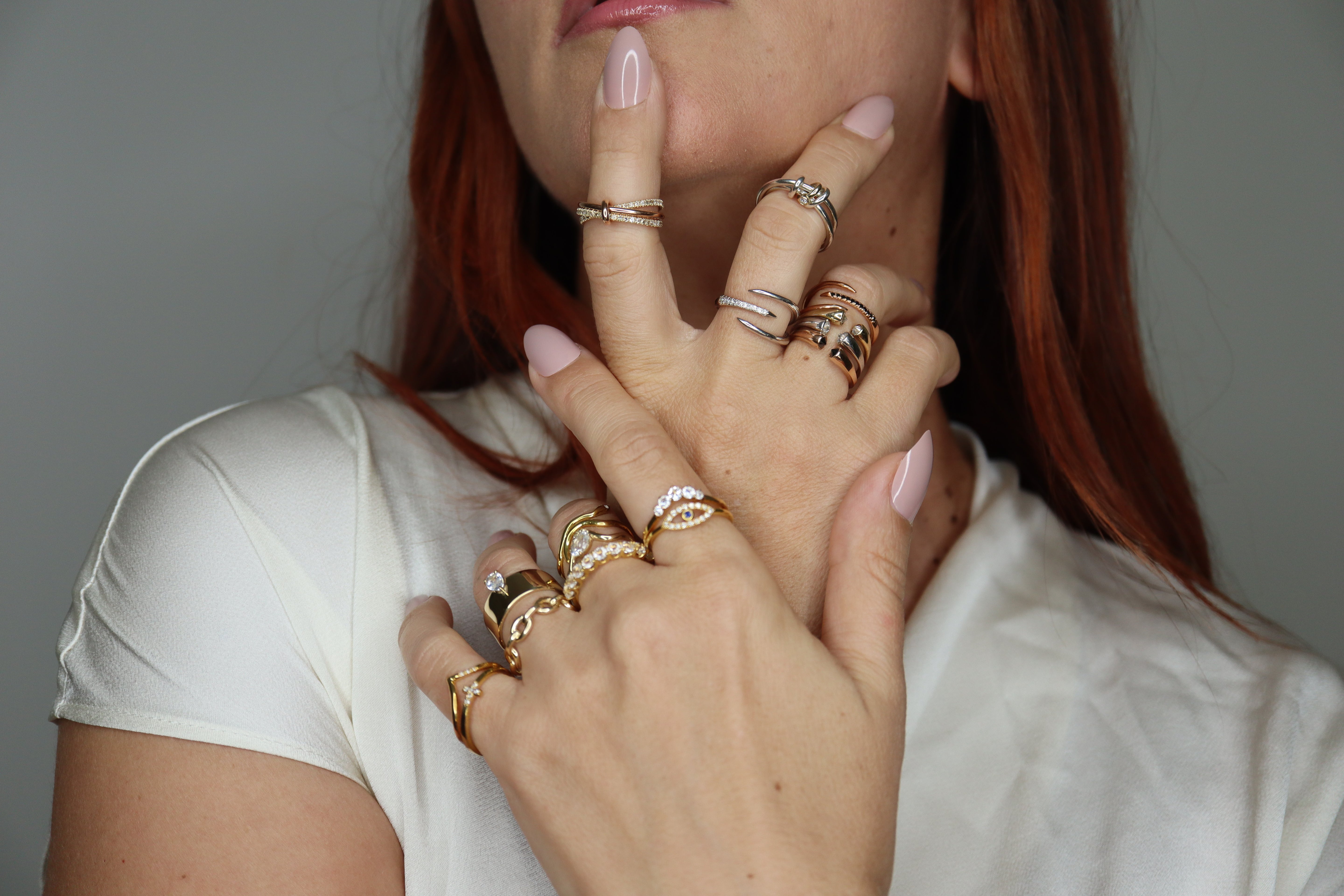
Mixed metal / tri-color combines two or three gold colors within a single ring. This is where kinetic rings become particularly striking - different-colored components move past each other, creating a constantly shifting color pattern. The Aria uses all three gold tones in its rolling bands. The Elysium pairs two gold colors in connected parallel bands. Mixed metal eliminates the need to match your ring to other jewelry because it already contains multiple tones.
Read the full gold color guide for skin tone matching, wardrobe pairing, and maintenance differences between colors.
Should You Choose Gemstones or an All-Gold Kinetic Ring?
Some kinetic rings feature diamond, ruby, sapphire, or champagne diamond accents set into the moving links or bands. Others are pure gold with no stones. Both approaches are equally valid - the choice is aesthetic, not qualitative.
Gemstone-set kinetic rings add sparkle and color variation to the movement. As links rotate, diamonds catch light from different angles. Rubies and sapphires introduce color contrast against the gold. The visual effect is richer and more complex. However, gemstone-set designs require slightly more care - soap residue can temporarily dull pavé stones (easily solved with warm water soaking).
All-gold kinetic rings emphasize the sculptural quality of the metal itself. The movement is about form, weight, and the play of light on polished gold surfaces rather than gemstone sparkle. All-gold designs tend to be slightly more understated and versatile across all contexts.
Popular gemstone-set kinetic rings: The Fiamma (ruby pavé on rose gold links), Seraphina (ruby eternity bands), Vortexa (diamond pavé on interlocking bands), and Trielle (sapphire pavé on rose gold links).
Popular all-gold kinetic rings: The Alizée (mixed metal links), Marque (yellow gold with diamond accent), and Harmony (minimal gold links).
What Band Width Is Best for Your First Kinetic Ring?
Width affects how the ring looks on your hand, how much it weighs, and how visually dominant it is. Kinetic rings range from slimmer profiles around 3-4mm to the widest designs at 6mm and above.
Slim profiles (3-4mm) are understated and stack-friendly. They work as everyday pieces that add movement without commanding attention. Designs like the Harmony and Eclisse sit in this range.
Medium profiles (4-5mm) balance presence with versatility. Most of Antoanetta's kinetic rings - including the Aria, Alizée, and Seraphina - fall in this range. Substantial enough to feel significant, refined enough for all occasions.
Wide profiles (5-6mm+) make a statement. The Marque at 6mm is the widest kinetic ring in the collection. It carries considerable visual weight and provides the most substantial tactile experience. Wide kinetic rings are best suited to the middle or index finger where their proportions feel balanced.
If you are new to kinetic jewelry, starting in the medium range gives you the most complete kinetic experience without the visual commitment of a wide statement piece. Read the wide band sizing guide if you are considering a 5mm+ design - wider bands may require ordering a half size up.
How Much Should You Spend on Your First Kinetic Ring?
Antoanetta's kinetic rings span a range of price points, and the quality of materials and construction is consistent across the entire collection - every ring uses solid 14k gold, hand assembly, and the same production process regardless of price. The cost differences reflect gold weight, number of components, gemstone inclusion, and design complexity.
Entry level ($250-$500): The Eclisse at $250 and the Harmony at $400. These are genuine solid gold kinetic rings with real movement - not stripped-down compromises. They use fewer components and less total gold than signature designs, making them an accessible starting point.
Core collection ($1,900-$2,500): This is where most of the kinetic ring collection lives. Designs like the Alizée (from $2,200), Aria (from $2,300), and Seraphina (from $2,500) offer the full kinetic experience with multiple moving components, mixed metals, and gemstone accents.
Signature pieces ($2,500+): The Vortexa (from $2,600), Marque ($2,600), and Aurelia (from $2,800) represent the most elaborate constructions with maximum gold weight, complex multi-component assemblies, and premium gemstone configurations.
If you are testing the concept for the first time, starting at the entry level lets you confirm that kinetic jewelry aligns with your preferences before investing in a signature piece. Many wearers begin with a Harmony and add a second, more elaborate kinetic ring within months once they experience the movement. Read the spending guide for a cost-per-wear analysis that reframes the investment.
Kinetic Ring Quick Reference: Which Ring Matches Your Preferences?
Want active fidgeting? → Articulated links → Alizée or Fiamma
Want passive, ambient movement? → Rolling bands → Aria or Vortexa
Want the most visual complexity? → Mixed metal with gemstones → Alizée (seven gemstone-set links in three gold colors)
Want the most understated option? → Single gold color, no stones → Harmony or Eclisse
Want the most substantial, tactile experience? → Wide band → Marque (6mm, three links, diamond accent)
Want rubies? → Rose gold → Seraphina or Fiamma
Want sapphires? → Rose gold → Trielle
Want the most affordable entry? → Eclisse at $250
How to Size Your First Kinetic Ring
Because every kinetic ring is made to order, getting your size right before production begins is important. Standard-width kinetic rings follow normal ring sizing. Wider designs (5mm and above) may benefit from ordering a half size up for comfort. Measure your ring size at home using our step-by-step guide, or contact the designer to discuss sizing for your specific design choice.
If you are between sizes, size up rather than down - especially for wider bands. A slightly roomier fit is always more comfortable than a tight one, particularly for a ring you intend to wear continuously.
What to Expect After Ordering a Kinetic Ring
Once you place your order, Antoanetta's atelier in Los Angeles begins production. The process takes approximately two to three weeks - each component is cast, polished, stone-set (if applicable), assembled, and quality-tested by hand. When your ring is complete, it ships via complimentary FedEx 2-Day delivery within the United States.
If you have questions at any point - before ordering, during production, or after receiving your ring - you communicate directly with the designer. Antoanetta is a small, family-run atelier, not a call center. Read the full made-to-order guide for a complete walkthrough of what to expect from order to unboxing.