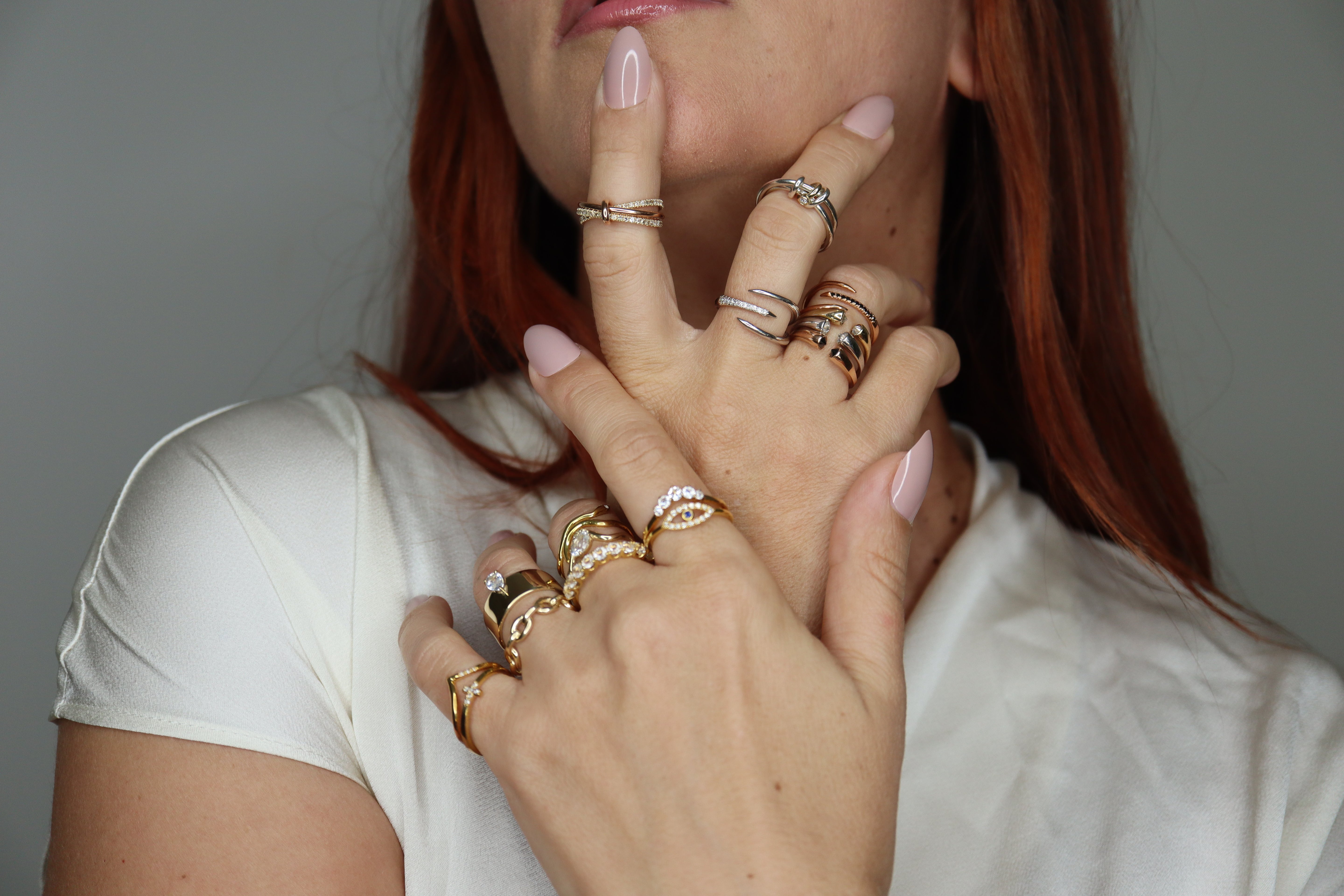





14K vs 18K vs 24K Gold for Rings: Which Karat Is Best for Daily Wear?
The best karat for daily wear rings is 14k gold, which offers the optimal balance between color richness, structural durability, scratch resistance, and price. Karat is the measure of how much pure gold is in an alloy. The higher the karat, the more gold - and the more beautiful, softer, and less practical the metal becomes for daily wear. For rings that live on your hand every day, this decision directly affects how the piece looks and performs over years of continuous use.
What Do 14K, 18K, and 24K Gold Mean?
14k gold contains 58.3% pure gold (14 parts gold, 10 parts alloy metals). The remaining 41.7% is copper, silver, and zinc - metals that add hardness, durability, and structural integrity. This is the most popular karat for fine jewelry in the United States and the standard used in all Antoanetta designs.
18k gold contains 75% pure gold (18 parts gold, 6 parts alloy metals). The higher gold content produces a richer, deeper yellow color and a slightly warmer tone. It is the dominant standard in European fine jewelry and is favored by many luxury brands.
24k gold is pure gold - 99.9% gold with no alloy metals. It has the richest, most saturated yellow-orange color. It is also the softest, heaviest, and least practical for jewelry that will be worn regularly. 24k gold is primarily used in investment bars, coins, and ceremonial jewelry rather than everyday rings.
The karat system divides gold into 24 equal parts. Every step up in karat means more gold and less alloy - which shifts the balance between beauty and practicality.
How Do 14K, 18K, and 24K Gold Compare in Hardness and Scratch Resistance?
This is where 14k gold gains its practical advantage. The higher alloy content in 14k gold makes it measurably harder than 18k or 24k. On the Vickers hardness scale, 14k yellow gold typically registers around 135-170 HV, while 18k yellow gold registers around 120-150 HV, and 24k gold drops to approximately 25-50 HV.
In daily wear terms, this means a 14k gold ring resists surface scratching significantly better than an 18k ring, and dramatically better than 24k. When you type on a keyboard, grip a steering wheel, set down a coffee cup, or brush your hand against any hard surface, your ring contacts that surface at a microscopic level. Harder gold deforms less under these contacts, meaning fewer and shallower scratches accumulate over time.
This difference is particularly important for kinetic rings. The moving components in an articulated link or rolling band design create internal friction every time the pieces shift. Harder 14k gold maintains its smooth contact surfaces better under this constant micro-abrasion than softer 18k or 24k gold would. This is one of the key reasons Antoanetta uses 14k exclusively for kinetic designs - the alloy's hardness is essential for long-term movement quality. Read how kinetic rings are engineered for more on why material hardness matters in moving jewelry.
How Does Gold Color Differ Between 14K, 18K, and 24K?
The gold content directly affects the color of the finished piece. Higher karat gold has a richer, more saturated yellow tone because there is simply more gold - and gold is inherently warm and yellow.
14k yellow gold has a warm, balanced yellow with a slight softness. The alloy metals temper the intensity of pure gold, creating a tone that reads as classic and refined without being overwhelming. It pairs naturally with every skin tone and complements both casual and formal settings.
18k yellow gold is noticeably richer and deeper in yellow saturation. Side by side with 14k, the difference is visible - 18k appears more "golden" and more luxurious in raw color terms. This richer tone is the primary reason many buyers choose 18k when budget allows.
24k yellow gold has a distinctive orange-yellow saturation that looks unlike any alloyed gold. It is immediately recognizable as pure gold. However, this deep color is not always flattering in ring designs - it can appear heavy or garish in certain lighting conditions and does not pair as universally with skin tones.
For white gold and rose gold, the alloy composition changes the equation entirely. White gold at both 14k and 18k is rhodium-plated to achieve its bright silvery appearance, so the karat difference is masked by the plating. Rose gold at 14k has a slightly stronger pink tone (more copper in the alloy) while 18k rose gold appears slightly more golden-pink. Explore the full gold color comparison for visual guidance on choosing between yellow, white, and rose.
How Does Gold Karat Affect Price?
Gold is priced by weight and purity. Because 18k gold contains 28% more pure gold than 14k (75% vs. 58.3%), an 18k ring of identical design and weight costs substantially more - typically 30-50% more depending on current gold spot prices and the jeweler's pricing structure. 24k gold costs even more, though it is rarely used in ring construction.
This price difference compounds in heavier designs. A kinetic ring with multiple components - several grams of gold across links, bands, connectors, and the main band - amplifies the per-gram cost difference into a significant total price increase at higher karats. The 14k formulation delivers the best value ratio: enough gold for genuine beauty and value retention, enough alloy for the hardness needed in daily-wear fine jewelry.
How Suitable Is Each Gold Karat for Daily Wear?
14k gold is purpose-built for daily wear. It handles showers, exercise, sleeping, cooking, typing, and every other routine activity without concern. The hardness resists scratching from incidental contact. The alloy composition resists deformation under pressure. It is the most practical karat for a ring you never intend to remove.
18k gold is suitable for daily wear with slightly more care. It scratches more easily than 14k and is marginally more prone to minor deformation under pressure (though this would require significant force). Many people wear 18k rings daily for decades without issue - the difference from 14k is measurable but not dramatic for most wearers. The primary trade-off is accepting that the softer gold will develop patina faster.
24k gold is not suitable for daily ring wear. It is soft enough to deform visibly under normal hand activities. A 24k gold ring can bend, scratch deeply, and lose its shape with regular use. It requires careful handling and storage, making it impractical as an everyday piece. 24k gold is best reserved for pendants, earrings, and investment pieces that do not encounter the constant mechanical stress that rings face.
How Does Gold Karat Affect Gemstone Setting Security?
Prongs, bezels, and pavé settings rely on the gold's ability to hold gemstones firmly in place. Harder gold grips stones more securely because the prong tips resist bending away from the stone over time. In 14k gold, pavé settings maintain their grip on small diamonds and gemstones for years of daily wear without loosening. In 18k gold, prongs may require occasional retightening - particularly in rings that experience frequent contact with hard surfaces.
For kinetic rings with gemstones set into moving links - like the Fiamma with ruby pavé on articulated links - stone security is critical because the gemstones experience both external contact and the micro-vibration of the moving mechanism. The 14k alloy's superior hardness provides an additional margin of security for stones in these demanding applications.
How to Choose the Right Gold Karat for Your Ring
Choose 14k if you plan to wear the ring every day without removing it, you prefer maximum durability and scratch resistance, you want the best value for your gold investment, or you are buying a kinetic ring where hardness directly affects movement longevity.
Choose 18k if you prioritize the richest possible gold color over maximum hardness, you do not mind slightly more rapid patina development, and you are comfortable with the 30-50% price premium for the higher gold content.
24k is best for investment purposes, ceremonial pieces, and jewelry that will be stored and worn only on rare occasions rather than daily.
Antoanetta works exclusively in 14k gold because the collection is designed for 24/7 wear - especially the kinetic pieces where material hardness directly determines movement quality and longevity. Read why solid 14k gold is worth the investment for the complete cost-of-ownership perspective.
Frequently Asked Questions About 14K, 18K, and 24K Gold for Rings
Can you tell the difference between 14k and 18k gold by looking at it?
Side by side, yes - 18k is visibly richer in yellow saturation. But in isolation, without a direct comparison, most people cannot distinguish between the two. The color difference is subtle enough that it rarely drives purchasing decisions on its own.
Is 10k gold too low quality for fine jewelry?
10k gold (41.7% gold) is legal in the United States and is durable, but it has noticeably less gold richness in color and carries lower intrinsic value. Most fine jewelry designers work in 14k or 18k. Antoanetta uses 14k as the optimal balance point.
Does karat affect allergic reactions?
Higher karat gold has less alloy content, which means less copper and zinc. However, quality 14k gold alloys (including Antoanetta's) contain no nickel - the primary jewelry allergen - making them safe for sensitive skin regardless of karat. Read more about 14k gold and skin reactions.
Can a 14k ring be converted to 18k?
No. The karat is determined by the alloy composition throughout the entire piece. You cannot add gold to an existing ring to change its karat. The karat is selected before casting and is permanent.