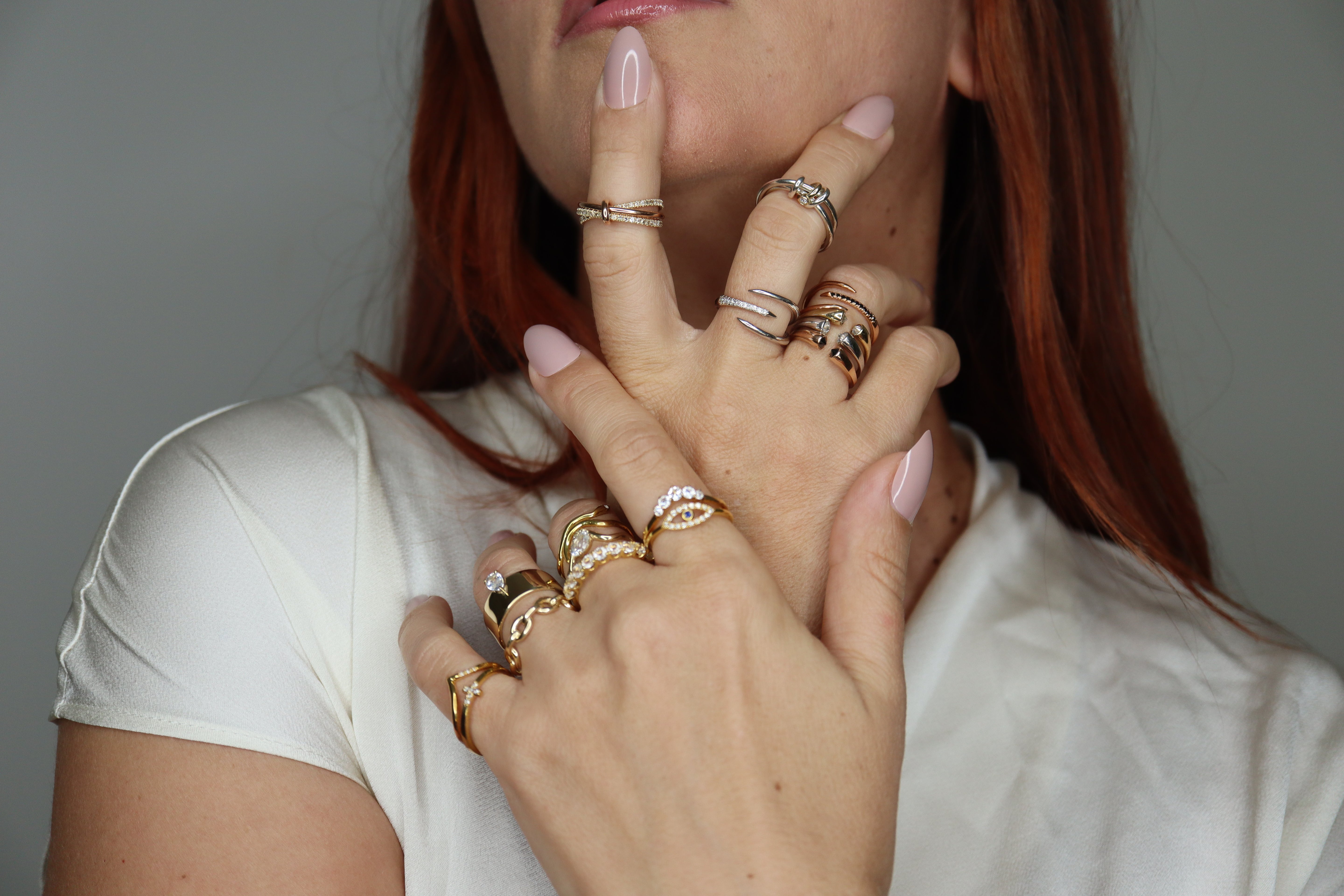





How Do Moving Gold Rings Actually Work? Inside the Engineering
Moving gold rings work by assembling five, seven, or more individual components, each fabricated separately, finished to precise tolerances, and joined into a structure that moves fluidly without binding, rattling, or wearing through. Unlike a static gold band that is cast as a single piece, polished, and finished, a kinetic ring is an assembly where the engineering behind the movement is invisible to the wearer. The ring simply glides. But making it glide required decisions about casting thickness, link geometry, surface finishing, and assembly sequence that take years of bench experience to execute consistently.
This guide takes you inside Antoanetta's Los Angeles atelier to explain how a kinetic ring goes from raw gold alloy to the moving piece of jewelry that arrives on your finger.
How Is a Kinetic Ring Designed for Movement?
Every kinetic ring begins with a design problem that static rings never face: how do you create components that move freely against each other without creating gaps wide enough to catch skin, edges sharp enough to pinch, or tolerances loose enough to rattle? The answer lives in the geometry of each link and the architecture of the central band structure.
For articulated link designs like the Alizée, each link has a curved interior channel that seats against the band. The channel must be wide enough to slide without resistance but narrow enough to prevent the link from lifting away from the finger. For rolling band designs like the Aria, the interlocking bands require a connector bridge that allows orbital rotation while keeping the bands nested concentrically. These specifications are calculated digitally and then refined through physical prototyping - the designer tests movement by hand before any production piece is cast.

How Are Individual Kinetic Ring Components Cast?
Antoanetta uses lost-wax casting - a technique with roots in ancient goldsmithing that remains the standard for fine jewelry production. Each component of a kinetic ring is cast separately. A seven-link articulated ring requires at minimum nine individual castings: the central band, seven individual links, and any connector or end-cap elements.
The process begins with a wax model of each component, carved in 3D to exact dimensions. The wax models are invested in a plaster-like material called investment, then heated in a kiln until the wax melts out, leaving a hollow mold. Molten 14k gold alloy (58.3% pure gold mixed with copper, silver, and zinc for hardness) is poured or vacuum-drawn into the mold. Once cooled, the investment is broken away to reveal the raw gold casting.
The alloy composition matters more in kinetic jewelry than in static pieces because the components undergo continuous friction against each other. The copper and silver in 14k gold provide the hardness needed for moving parts to maintain their shape and surface finish over years of daily use. Pure 24k gold would be too soft - the links would deform and the movement would degrade within months. The 14k formulation is specifically suited for this application.
How Are Kinetic Ring Components Finished and Polished?
Raw castings emerge from the mold with rough surfaces, minor imperfections, and residual investment material. Every component must be individually cleaned, filed, and polished before it can be assembled into a moving structure.
This is where kinetic ring production diverges most sharply from static ring production. A standard band has one exterior surface and one interior surface to polish. A kinetic ring with seven links has fourteen link surfaces (front and back of each), plus the band's own interior and exterior, plus every edge and channel where components will contact each other. Each of these surfaces must be polished to a standard where gold-on-gold movement feels smooth rather than gritty.
Antoanetta's bench jewelers use graduated polishing techniques - moving from coarser abrasives to progressively finer compounds - to achieve a mirror finish on visible surfaces and a satin-smooth finish on contact surfaces. The contact surfaces are particularly critical: too rough and the links will grind against each other, creating resistance and eventually wearing through. Too mirror-smooth and the links may slide too freely, creating a loose, uncontrolled feel. The target is a specific level of controlled friction that produces the "liquid weight" sensation the brand is known for.
How Are Gemstones Set in Moving Ring Components?

Designs that incorporate diamonds, rubies, or sapphires require stone setting before final assembly - because once the links are threaded onto the band, individual access to each link's surface becomes limited.
Pavé setting on a moving link is more demanding than pavé on a static band. The stone setter must secure each gemstone firmly enough that it will not loosen under the constant micro-vibration of moving components, while keeping the prongs or beads low enough that they do not interfere with the link's movement path. On the Fiamma, natural rubies are pavé-set along rose gold links that will spend their entire life sliding back and forth - every stone must be set to withstand that continuous motion without loosening over years of daily wear.
Stones are selected individually for color consistency and clarity. In a kinetic ring, the links rotate and shift, meaning stones are viewed from multiple angles throughout the day. Any inconsistency in color or inclusion visibility becomes more apparent when the stone is constantly changing its orientation relative to the viewer's eye. Antoanetta's bench jewelers select stones that perform well from all angles, not just the traditional face-up position.
How Are Kinetic Rings Assembled and Calibrated?
This is the step that makes kinetic rings fundamentally different from any other type of jewelry. Once all components are cast, polished, and stone-set, they must be assembled into a structure that moves.
For articulated link designs, the links are threaded onto the central band in a specific sequence - particularly in mixed-metal designs where the gold color order affects the visual pattern. The band endpoints are then secured (either closed by soldering or mechanically fastened depending on the design) to permanently capture the links. At this point, the jeweler tests movement: each link should slide freely from one end of the band to the other without catching, binding, or tilting.
For rolling band designs, the interlocking bands are fitted through their shared connector bridge and tested for orbital rotation. The bridge must allow full 360-degree rotation of each band while preventing the bands from separating. This is precision assembly work - the tolerances between the bridge bore and the band channel are fractions of a millimeter, and any misalignment causes binding or uneven rotation.
Calibration is not a one-and-done process. The jeweler tests movement repeatedly, makes micro-adjustments to contact surfaces, retests, and continues until the motion meets the quality standard: smooth, fluid, silent, and consistent across the full range of positions. A ring that moves beautifully in one position but catches in another is not finished.
How Is a Kinetic Ring Inspected Before Shipping?
Before any kinetic ring leaves the atelier, it undergoes a final quality check. The designer personally inspects the movement, the finish quality, the gemstone security, and the overall appearance. Because Antoanetta is a small family operation, not a factory with separate quality departments, the standard is personal: does this ring meet the level of craftsmanship the designer would want on her own hand?
Once approved, the ring is packaged and shipped via complimentary FedEx 2-Day delivery within the United States. The total production timeline from order to delivery is approximately two to three weeks - reflecting the reality that each ring is individually fabricated, assembled, and tested rather than pulled from inventory.
Why Can't Kinetic Ring Production Be Rushed or Automated?

Mass-produced spinner rings are stamped from sheet metal, assembled by machine, and shipped in bulk. The movement is functional but imprecise - the spinning band rotates because the tolerances are loose, not because they are calibrated. The rings cost $15 because the production cost is negligible.
A kinetic ring from Antoanetta takes two to three weeks because the process is inherently manual. Lost-wax casting cannot be meaningfully accelerated. Hand-polishing contact surfaces to the right friction level cannot be replaced by machine buffing. Gemstone setting on moving components requires a skilled setter working under magnification. Assembly and calibration demand a bench jeweler who can feel the difference between correct movement and almost-correct movement.
This is what the production timeline represents: not delay, but the time required for human hands to create something that moves beautifully on yours. Read the comparison of handmade vs. mass-produced jewelry for a deeper look at what craftsmanship adds to every piece.
Frequently Asked Questions About How Kinetic Rings Are Made
How many individual components are in a kinetic ring?
It depends on the design. A three-link articulated ring has at minimum five components (band, three links, connectors). A seven-link design like the Alizée has nine or more. Rolling band designs like the Aria typically have four to five components (two or three bands plus the connector bridge and any accent elements).
Is lost-wax casting the same method used in ancient jewelry?
Yes - the fundamental principle dates back over 5,000 years. Modern jewelers use the same concept (creating a mold from a wax model) but with refined materials, controlled kiln temperatures, and vacuum-assisted casting for consistent results. The technique endures because it produces the highest quality solid gold components with the most precise detail.
Can I visit the atelier to see the process in person?
Contact the designer to discuss atelier visits or custom design consultations. As a small family operation, visits are arranged personally rather than through an open-door policy.
Does the movement degrade over time?
In solid 14k gold, no. The alloy's hardness prevents the kind of surface wear that would affect movement quality. A kinetic ring will move the same way after ten years of daily wear as it did when new. This is one of the primary reasons all components are fabricated in solid gold rather than plated alternatives - plating would wear through at friction points and compromise movement within months.