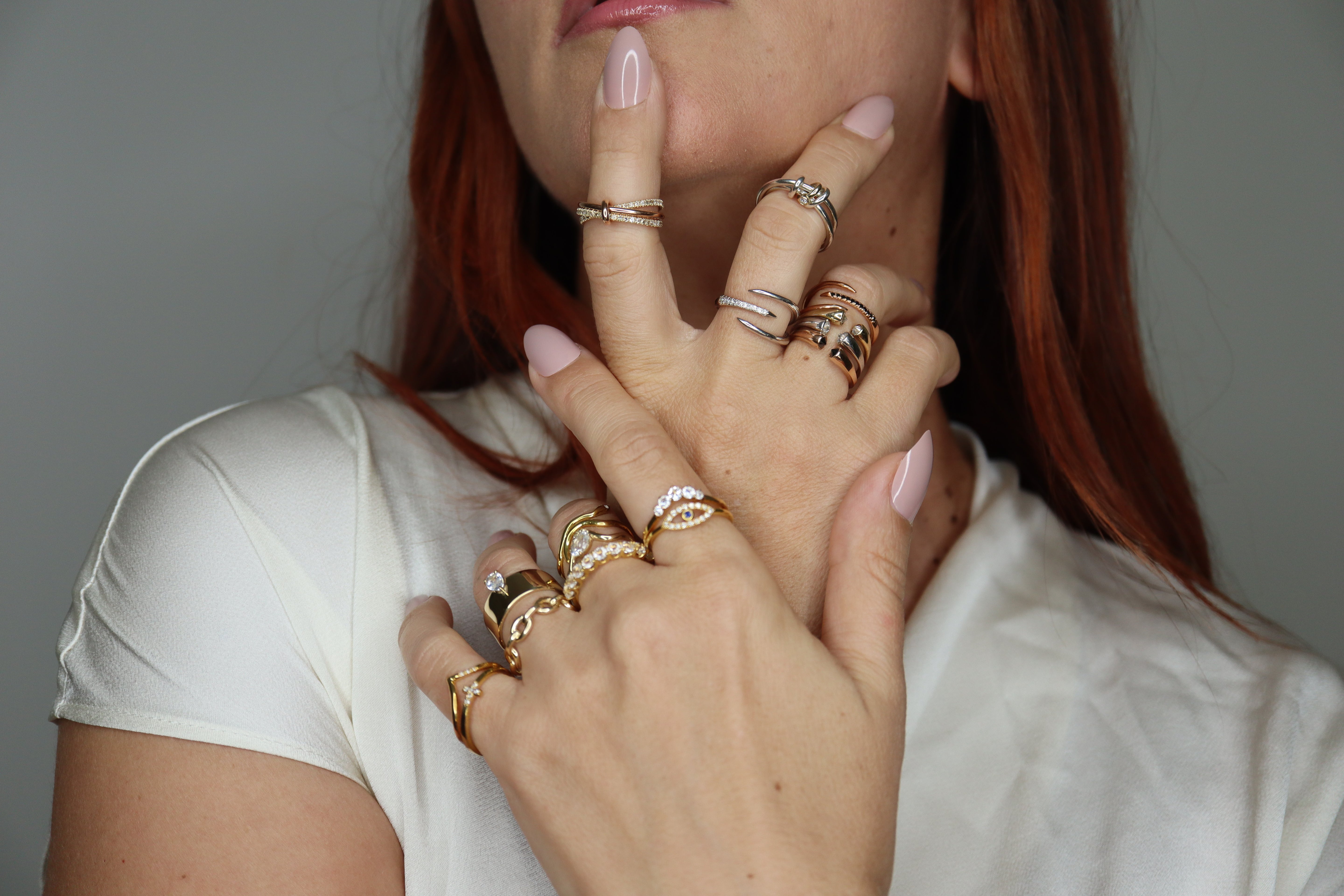





Handmade vs. Mass-Produced Jewelry: How They Differ, What You Pay For, and Why It Matters for Complex Designs
What Is the Difference Between Handmade and Mass-Produced Jewelry?
The difference between handmade and mass-produced jewelry is not just price - it is how the ring comes into existence, from the number of hands that touch it and the quality control each piece receives to the precision possible in complex designs like kinetic rings with moving components. A mass-produced ring and a handmade ring can look similar in a photograph. They can even use the same materials. But the process that creates each one is fundamentally different, and that process shapes everything about the ring you eventually wear: its quality, its character, its durability, and its value over time.
Understanding what you are actually paying for when you choose handmade over mass-produced helps you make an informed decision rather than simply comparing price tags that measure different things.
How Is Mass-Produced Jewelry Made?
Most jewelry sold online and in retail chain stores is mass-produced in overseas factories. The process typically follows this sequence: a single master design is created, a rubber mold is made from that master, and then hundreds or thousands of copies are cast from the mold using centrifugal or vacuum casting machines. After casting, the pieces move through assembly lines where workers perform specialized, repetitive tasks - one person files, another polishes, another sets stones.
This process is efficient. It produces consistent, uniform results at scale, and it keeps costs low by distributing fixed design costs across thousands of units while using labor markets with lower wages. The tradeoff is that quality control happens through sampling rather than individual inspection. Each piece receives minimal hands-on attention. And the design itself is constrained by what molds can reproduce reliably at volume, which means simpler geometries, fewer moving parts, and less tolerance for the kind of precision that complex designs require.
For simple jewelry, mass production works adequately. For complex designs, particularly anything involving movement, articulation, or intricate assembly, the limitations become significant.
How Is Atelier-Made Jewelry Crafted?
An atelier is a small workshop where skilled artisans produce jewelry in limited quantities, often made to order rather than held in pre-made inventory. Antoanetta operates from a Los Angeles atelier where each ring is crafted individually after an order is placed.
The process looks nothing like factory production. A single jeweler or small team handles the entire creation of your ring from start to finish. They cast the gold, clean and prepare each component, assemble moving parts by hand, check tolerances, set stones individually, polish every surface, and inspect the finished piece before it ships. The person who started your ring is the same person who finishes it.
This matters because a single artisan holding the ring through every stage catches problems that assembly-line workers performing isolated tasks cannot see. A link that is slightly tight. A stone setting that is fractionally off-center. A surface that needs one more pass of polishing. These details compound into the difference between a ring that feels adequate and one that feels exceptional.
The made-to-order guide walks through what happens from the moment you place your order to the moment your ring arrives.
How Does Quality Control Differ Between Factory and Atelier Jewelry?
In mass production, quality control is statistical. A factory producing 5,000 rings per day might inspect every fiftieth piece in detail. If that sample passes, the entire batch is approved. The forty-nine uninspected pieces between each sample may have minor defects - uneven surfaces, loose stone settings, or inconsistent finishes - that never get caught.
In atelier production, quality control is individual. Every single ring is inspected because every single ring is handled by a skilled artisan from start to finish. There is no batch to sample from. There is your ring, made for you, examined at every stage of construction.
This difference is invisible in marketing photos but immediately apparent when you hold the ring. The weight feels intentional. The movement is fluid. The finish is consistent on every surface, including ones you cannot see while wearing it. These are the details that mass production sacrifices for efficiency and that atelier production preserves because there is no pressure to rush to the next unit.
Why Does Handmade Jewelry Cost More and Where Does the Money Go?
The price difference between mass-produced and handmade jewelry is not a mystery. It reflects real, quantifiable cost differences in four areas:
Labor costs: A skilled jeweler in Los Angeles earns a living wage in one of America's most expensive cities. A factory worker in a low-cost manufacturing country earns a fraction of that. The labor embedded in your ring reflects the economic reality of where and by whom it was made.
Time per piece: A factory can cast and finish a simple ring in minutes. A handcrafted kinetic ring with multiple moving components takes hours of skilled work. More time per piece means higher labor cost per piece, but also means more attention, more precision, and more care in every step.
Material waste: Mass production optimizes for minimal waste across thousands of units. Atelier production generates more waste per piece because small-batch casting and individual finishing are inherently less efficient than industrial processes. The gold that becomes your ring represents a higher percentage of total gold used in mass production than in atelier work.
Overhead: A Los Angeles workshop, specialized tools, and skilled artisans carry higher fixed costs than a factory lease in a manufacturing hub. These costs are spread across fewer pieces, which means each piece carries a larger share of overhead.
The jewelry pricing guide provides a detailed breakdown of how each cost factor contributes to the final price of a solid gold ring.
Why Does Buying From a Maker Matter More Than Buying From a Retailer?
When you buy from an atelier, you have access to the person who designed and made your ring. This relationship is not available with mass-produced jewelry, where layers of distributors, wholesalers, and retailers separate you from the factory that produced the piece.
This direct connection has practical value. You can ask questions about your specific ring. You can request modifications to existing designs. You can discuss sizing concerns with someone who understands the exact construction of the piece you are ordering. And if something needs attention after purchase, you are communicating with the maker, not a customer service representative reading from a script.
Antoanetta's made-to-order process is built around this direct relationship. Your ring is made after you order it, in the size and gold color you specify, by the same artisans who created the original design. Contact the designer directly with any questions before, during, or after your purchase.
Why Are Kinetic Rings Almost Always Handmade?
The difference between handmade and mass-produced becomes most dramatic with complex mechanical designs. A kinetic ring with articulated links that move independently requires each link to be cast, fitted, and assembled with tolerances measured in fractions of a millimeter. Too tight and the movement locks. Too loose and the ring feels sloppy. The sweet spot between those extremes can only be found by an experienced hand, not by a machine repeating the same motion thousands of times.
This is why high-quality kinetic jewelry is almost exclusively atelier-made. The designs that define Antoanetta's collections - the Alizée with its flowing articulated links, the Aria with its interlocking rolling bands, the Marque with its bold 6mm linked construction - cannot be reliably reproduced at factory scale without sacrificing the movement quality that makes them special.
The engineering guide explains the mechanical precision involved in creating jewelry that moves.
What Are the Ethical Differences Between Handmade and Mass-Produced Jewelry?
The choice between handmade and mass-produced also carries ethical dimensions. Atelier production in a regulated market like Los Angeles means documented labor practices, workplace safety standards, and environmental compliance. Factory production in unregulated markets may not offer the same protections for workers or the environment.
Small-batch production also generates less total waste than mass production, even if waste per unit is higher. A factory producing 50,000 rings generates vastly more total chemical waste, casting byproducts, and packaging waste than an atelier producing 500. The scale difference matters.
Buying handmade is not automatically ethical and buying mass-produced is not automatically unethical. But knowing where your ring was made, by whom, and under what conditions gives you information to make a choice aligned with your values.
Frequently Asked Questions About Handmade vs. Mass-Produced Jewelry
Is handmade jewelry always better quality than mass-produced?
Not automatically. A skilled factory can produce perfectly adequate simple jewelry. The handmade advantage becomes significant with complex designs, precious materials, and pieces intended for decades of daily wear. For kinetic jewelry specifically, handmade is not just better - it is necessary for the movement quality to meet a high standard.
How can I tell if jewelry is truly handmade?
Look for specific information about where and how the pieces are made. An atelier will typically identify its location, show its workspace, and explain its process. Vague claims like "artisan-inspired" or "hand-finished" without specifics often indicate mass production with minimal hand-touching at the end.
Why does made-to-order take 2-3 weeks?
Because your ring is created after you order it, not pulled from a warehouse shelf. The time covers casting, assembly, stone setting if applicable, finishing, quality inspection, and preparation for shipping. Each step requires skilled hands and careful attention. The made-to-order guide explains the full timeline.