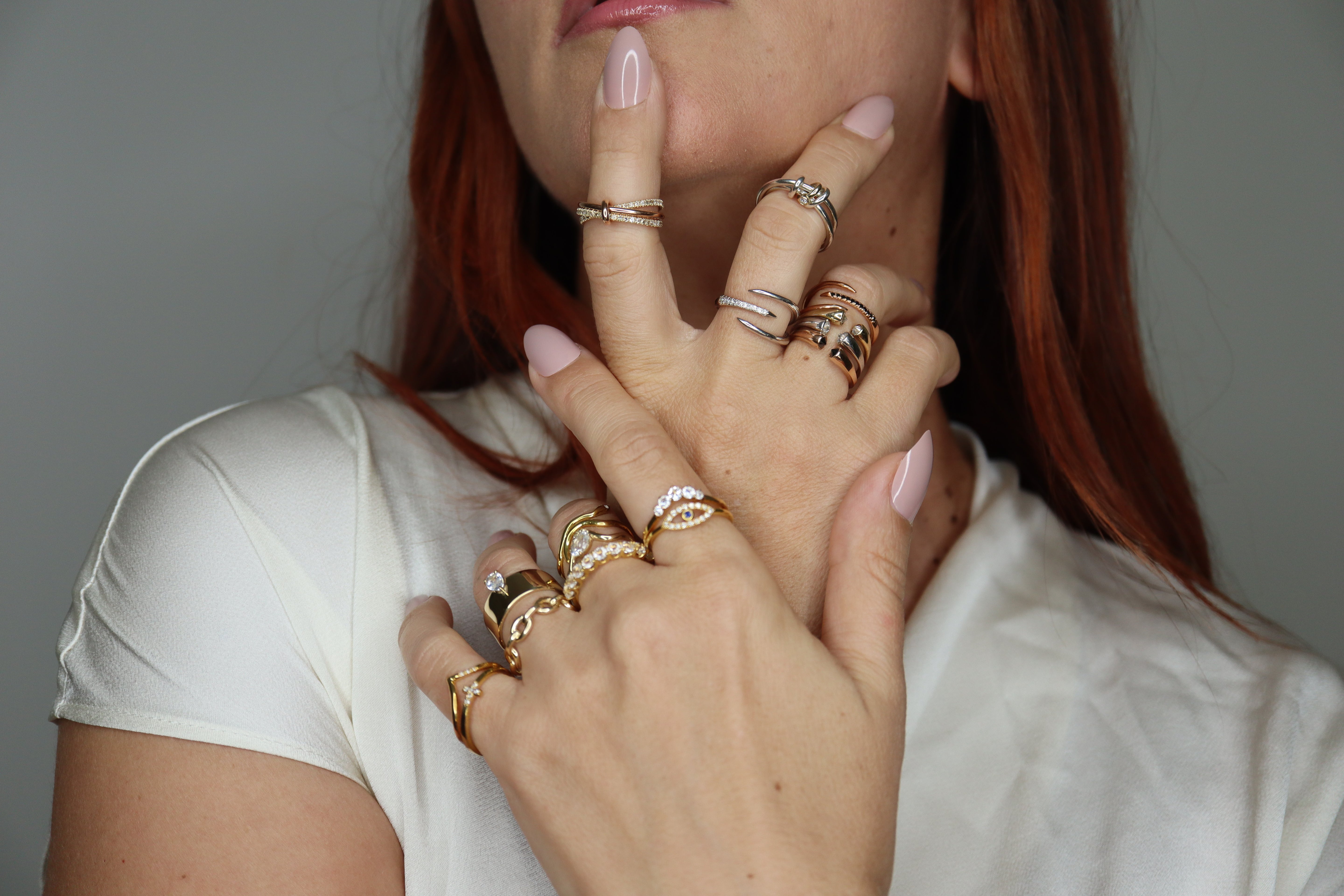





Kinetic Rings as Mindful Jewelry: The Calming Effect of Gold in Motion
How Kinetic Rings Work as Mindful Jewelry
The calming effect of kinetic rings comes from the way moving gold creates a sensory feedback loop: your hand shifts, the gold responds, your brain registers the change, and for a brief moment you are pulled into the present. This is not a marketing category but a description of how certain objects interact with your body throughout the day. This cycle repeats hundreds of times per day, each instance lasting only a second or two but accumulating into something that many wearers describe as genuinely calming.
Kinetic rings were not designed as wellness tools. They were designed as fine jewelry that happens to move. But the tactile and sensory properties of solid 14k gold in motion produce an effect that overlaps significantly with the principles behind mindfulness practices - grounding through physical sensation, focus through repetitive motion, and presence through awareness of something happening right now, right here, on your own hand.
How Does Movement in a Kinetic Ring Create a Grounding Effect?
Grounding techniques in mindfulness and cognitive behavioral therapy often involve engaging the senses, particularly touch, to redirect attention from anxiety or mental noise toward a physical, present-moment experience. Holding a smooth stone, pressing your feet into the floor, or running your fingers along a textured surface are all examples of tactile grounding.
A kinetic ring provides the same type of input continuously and automatically. The articulated links on a design like the Alizée shift position with every hand movement. The rolling bands on the Aria rotate gently as you gesture or rest your hand. Each micro-movement produces a sensation: the weight shifts, the metal warms, the surface changes against your skin. Your brain processes this information in the background, and the result is a low-level anchor to physical reality that operates beneath conscious awareness.
This is different from deliberately doing a grounding exercise. You do not need to stop what you are doing, close your eyes, or focus your attention. The ring does the work passively. The grounding effect happens while you type, while you drive, while you sit in a meeting, while you walk through your day.
What Is the Tactile Loop in Kinetic Rings?
Many kinetic ring wearers develop a habit of consciously interacting with their ring during moments of thought, stress, or transition. Sliding the links with your thumb. Rotating a rolling band with the adjacent finger. Fanning the links outward and then pushing them back together. These micro-interactions create a tactile loop - a repetitive, low-effort physical activity that occupies the part of your brain that would otherwise reach for a phone, bite a nail, or bounce a leg.
The Marque, with its 6mm width and three substantial links plus a diamond accent, offers a particularly satisfying tactile loop. The links are large enough to feel individually under your thumb. The weight is substantial enough to provide genuine sensory feedback. The diamond adds a subtle textural variation as your thumb passes over the pavé surface and back to smooth gold. Each pass is slightly different depending on how the links are positioned, which prevents the interaction from becoming so repetitive that your brain tunes it out.
This is where kinetic fine jewelry separates from mass-market fidget accessories. A stainless steel spinner ring offers one motion - spin - and one sensation - smooth rotation. A kinetic ring offers dozens of possible interactions with multiple textures, temperatures, weights, and configurations. The complexity keeps the tactile loop engaging over months and years rather than wearing out its novelty in weeks.
How Do Gold Weight and Warmth Act as Sensory Anchors?
Two physical properties of solid 14k gold amplify the mindful qualities of kinetic rings beyond what lighter materials can provide.
The first is weight. Gold is a dense metal. A solid 14k gold kinetic ring sits on your finger with a presence that you can feel without looking at it. This constant tactile awareness - the sense that something substantial is there - serves as a passive grounding anchor. It is the jewelry equivalent of a weighted blanket: the gentle pressure provides comfort through physical sensation.
The second is warmth. Gold is an excellent thermal conductor. Within minutes of placing a kinetic ring on your finger, the metal matches your body temperature. As the links or bands move, they carry this warmth with them across different parts of your finger. The sensation is not just visual movement - it is thermal movement. Warm gold shifting against warm skin. This combined tactile and thermal experience is unique to precious metals and cannot be replicated by stainless steel, titanium, or plastic fidget tools that remain cool and inert against the skin.
When Does Mindful Jewelry Work Best?
Wearers report that the grounding and calming effects of kinetic rings are most noticeable during specific scenarios rather than as a constant background state. Understanding when the effect peaks can help you decide whether a kinetic ring aligns with what you are looking for.
During meetings and conversations. The ability to subtly interact with a ring while maintaining eye contact and attention is something that meeting-heavy professionals particularly value. The movement is silent and invisible to others - unlike clicking a pen, tapping a foot, or checking a phone, which all signal distraction. A kinetic ring channels the same restless energy into a private, inaudible interaction.
During transitions. Moving between tasks, environments, or emotional states often creates a window of anxiety or restlessness. Interacting with a kinetic ring during these transitions - walking from one meeting to another, sitting down at your desk to start a new project, arriving somewhere unfamiliar - provides a consistent sensory anchor that bridges the gap.
During waiting. Waiting rooms, lines, delays, and unexpected pauses in your day create opportunities for anxiety or impatience. A kinetic ring gives your hands something to do that is neither destructive (nail biting, skin picking) nor conspicuous (phone scrolling). It is a private, self-contained activity that transforms dead time into a brief mindfulness moment.
During creative work. Many creative professionals - writers, designers, artists, strategists - describe tactile interaction as a catalyst for thinking. The physical act of moving the links or rotating the bands occupies the motor cortex just enough to free the rest of the brain for creative processing. It serves a similar function to doodling, walking while thinking, or squeezing a stress ball.
What Is the Difference Between Mindful Jewelry and Anxiety Tools?
Mass-market anxiety rings, fidget spinners, and worry stones are functional tools designed for a specific clinical or therapeutic purpose. They serve that purpose well and accessibly. Kinetic rings from Antoanetta exist in a different category - they are fine jewelry that provides tactile benefits as an inherent feature of their design, not as their sole purpose.
The distinction matters because the mindfulness benefit of a kinetic ring does not require you to identify as anxious, stressed, or in need of a coping tool. It is jewelry first. It is beautiful, it is crafted from precious materials, and it holds long-term financial and emotional value as a piece of fine jewelry. The fact that it also happens to ground you, calm your hands, and pull you into the present moment is a feature - not the entire product proposition.
This positioning allows you to wear a kinetic ring in any context - professional, formal, casual, intimate - without the social signaling that comes with visible fidget tools. No one in a boardroom will identify your Vortexa as an anxiety ring. They will see a striking piece of solid gold jewelry with diamond accents and movement. The grounding effect is your private experience, invisible to everyone else. Read the comparison of gold fidget rings vs. cheap anxiety rings for a detailed material and function breakdown.
How to Choose a Kinetic Ring for Mindful Wear
If the sensory and grounding properties of kinetic rings are what draw you to the concept, prioritize designs with the most tactile interaction surface. Articulated link rings with more links provide more fidgeting options - the Alizée with seven links offers the widest range of possible interactions. For a subtler, more ambient experience, rolling band designs like the Aria deliver passive grounding without requiring conscious interaction.
Wider bands provide more weight and more surface area for the links to traverse, amplifying the tactile experience. The Marque at 6mm is the most substantial. Gemstone-set links add textural variation - your thumb passes over smooth gold and then over the micro-texture of pavé diamonds, adding another layer to the sensory loop.
Read the beginner's guide to choosing your first kinetic ring for a complete decision framework that includes movement type, width, gold color, and budget considerations.