



Colored Gemstone Engagement Rings: A Complete Guide to Non-Diamond Options
What Are the Best Non-Diamond Gemstones for Engagement Rings?
The best non-diamond gemstones for engagement rings include ruby, sapphire, moissanite, morganite, and aquamarine, each offering unique color, proven daily-wear durability, and personal meaning that a colorless diamond does not provide. Colored gemstone engagement rings are no longer the alternative choice - they are the informed choice. A growing number of women are selecting engagement rings based on color preference, personal meaning, durability data, and design artistry rather than defaulting to a colorless diamond. The result is a shift toward rings that express individual identity while meeting every practical requirement for a lifetime of daily wear.
This guide evaluates every gemstone suitable for an engagement ring you will wear every day for decades. Each stone is assessed on the criteria that actually matter for lifetime wear: hardness, toughness, color stability, care requirements, and how each performs in kinetic ring settings where moving components add both beauty and structural demands.
What Are the Non-Negotiable Requirements for an Engagement Ring Stone?
An engagement ring is not occasional jewelry. It is worn every day, typically never removed, through every activity your life involves. The stone must meet three requirements without compromise:
Hardness above 7 on the Mohs scale. Below this threshold, the stone will gradually scratch and dull from contact with quartz mineral dust present on most surfaces. For kinetic rings, 7.5+ is the practical minimum due to the continuous micro-movements. Read the complete hardness guide for the full explanation.
Stable color. The stone's color must not fade, shift, or degrade from sunlight, heat, body chemistry, or chemical exposure. All stones recommended in this guide have permanently stable color.
Adequate toughness. The stone must resist chipping and breaking from the occasional impacts that daily life involves - setting down a heavy bag, catching a doorframe, gripping a barbell. Hardness alone does not guarantee toughness; some hard stones have cleavage planes that make them brittle.
Tier 1 Engagement Ring Gemstones: Supreme Durability (Mohs 9-10)
Diamond - Mohs 10
The hardest natural substance. Nothing scratches diamond in daily life. Its sparkle is predominantly white brilliance with spectral fire. Diamond is the traditional engagement stone and remains the most popular choice worldwide. The Vortexa sets diamond pavé across rolling interlocking bands - diamonds in constant orbital motion on solid 14k gold. Read the diamond pavé guide.
Moissanite - Mohs 9.25-9.5
Harder than sapphire, with more fire than diamond and superior impact toughness. Lab-created with full ethical traceability. The Eirwen sets moissanite within a kinetic architecture where the stone's exceptional hardness and brilliance serve a design built for lifetime daily wear. Moissanite delivers maximum visual impact at a price point that allows greater investment in the ring's gold and craftsmanship. Read moissanite vs. diamond.
Ruby - Mohs 9
The most durable colored gemstone, sharing corundum's supreme hardness with sapphire. Ruby's vivid red carries unmatched emotional symbolism - love, passion, vitality. Three Antoanetta kinetic designs feature ruby: the Fiamma (ruby pavé on moving rose gold links), Seraphina, and Brasa. A ruby engagement ring will look identical after 50 years of daily wear. Read the ruby guide.
Sapphire - Mohs 9
Available in blue, pink, yellow, teal, padparadscha (pink-orange), and virtually every other color except red. The most popular colored engagement ring stone worldwide, validated by centuries of use. The Trielle sets sapphire pavé on moving rose gold links. All sapphire colors share the same 9-Mohs hardness. Read the sapphire guide.
Tier 2 Engagement Ring Gemstones: Excellent Durability (Mohs 7.5-8.5)
Alexandrite - Mohs 8.5
The color-change gemstone: green in daylight, red under incandescent light. Extremely hard, very rare in fine qualities, and fascinatingly dynamic. An alexandrite engagement ring offers something no other stone can - a ring that literally changes color as you move between environments. Its 8.5 Mohs rating places it firmly above the daily-wear threshold. Available through custom design.
Spinel - Mohs 8
Available in vivid red, hot pink, and cobalt blue. Spinel is harder than all beryl varieties, requires no treatment, and has recently surged in collector appreciation. A red spinel engagement ring offers ruby-like color at lower price points with excellent durability. Available through custom design.
Aquamarine - Mohs 7.5-8
Cool blue beryl with excellent clarity and good toughness. Its "something blue" connection adds a wedding tradition to the engagement ring itself. The Dahlia and Lazura set aquamarine on kinetic gold links. Read the aquamarine guide.
Morganite - Mohs 7.5-8
Warm pink beryl that pairs seamlessly with rose gold. Its romantic color and excellent clarity make it one of the fastest-growing engagement ring stones. The Rosée and Lionna set morganite on moving rose gold links. Read the morganite guide.
Emerald - Mohs 7.5-8 (with caveats)
Vivid green with unmatched character. Emerald's hardness is adequate, but its inclusions reduce practical toughness. An emerald engagement ring requires a protective setting design and slightly more mindful daily wear than harder alternatives. For the wearer who loves emerald's unique green and accepts its character, it can serve beautifully as an engagement stone - as it has for royalty and collectors for centuries. Read the emerald guide.
Tier 3 Engagement Ring Gemstones: Adequate With Care (Mohs 7-7.5)
Tourmaline - Mohs 7-7.5
Available in pink, green, blue, watermelon (pink-green), and virtually every other color. Tourmaline at 7.5 Mohs is acceptable for daily-wear engagement rings with reasonable care. At exactly 7 Mohs, it sits at the threshold and may show gradual wear over decades. Best suited for wearers who will remove the ring for physical activities.
Garnet (Tsavorite, Rhodolite) - Mohs 7-7.5
Tsavorite garnet offers a vivid green that rivals emerald with better clarity and toughness. Rhodolite shows a beautiful purplish-red. Both are adequate for daily wear at 7-7.5 Mohs, though they lack the hardness margin of sapphire or ruby.
Which Gemstones Should You Avoid for Engagement Rings?
Below 7 Mohs, a stone will gradually accumulate scratches from daily wear. For a ring worn every day for a lifetime, the following popular stones are not recommended despite their beauty:
Tanzanite (6-7 Mohs): Beautiful violet-blue but too soft for daily wear. Reserve for dress rings or pendants.
Opal (5.5-6.5 Mohs): Stunning play-of-color but extremely soft, brittle, and vulnerable to dehydration. Not suitable for engagement rings.
Pearl (2.5-4.5 Mohs): Far too soft for ring settings worn daily. Scratches from fingernail contact.
Moonstone (6-6.5 Mohs): Beautiful adularescence but too soft for everyday ring wear.
Why Does Kinetic Design Change the Engagement Ring Equation?
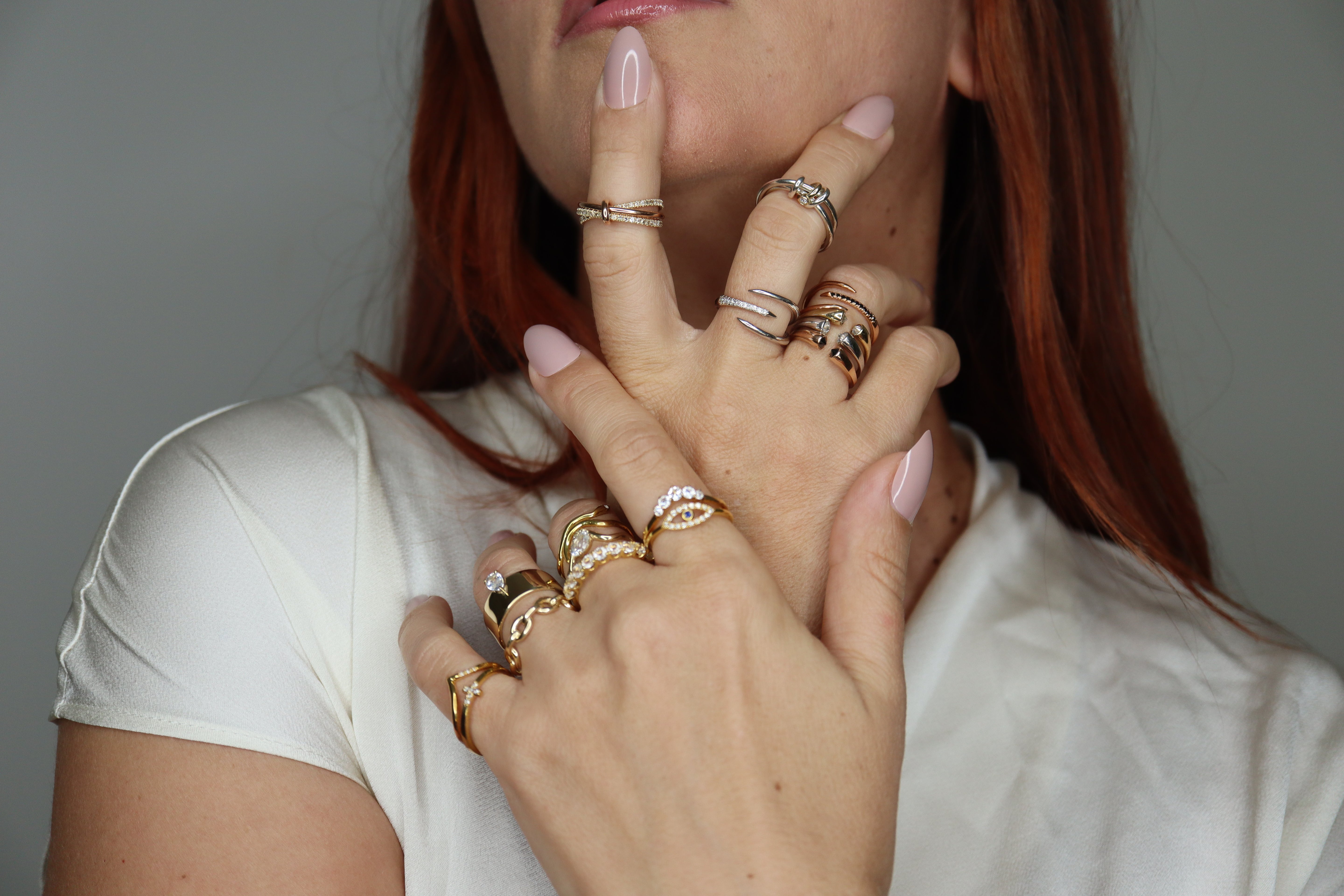
Traditional engagement rings are static. They sit on the finger and present the same visual from every angle at every moment. A kinetic engagement ring from Antoanetta adds a dimension that static rings cannot offer: the ring moves. Links articulate. Bands orbit. Components slide and rotate as your hand moves through the day.
This transforms the engagement ring from a symbol you wear into an experience you feel. The gentle weight redistribution as links shift, the changing light patterns as surfaces rotate, the tactile feedback of a ring that responds to your movements - these sensory qualities make a kinetic engagement ring something you actively engage with rather than passively display.
Every gemstone in Antoanetta's kinetic collection has been selected specifically for this application. The stones are hard enough to withstand continuous movement. The settings are engineered for motion-specific stresses. The designs are handcrafted in Los Angeles by an atelier that has refined kinetic ring engineering since 2005.
Frequently Asked Questions About Colored Gemstone Engagement Rings
Which colored gemstone is best for an engagement ring?
Ruby and sapphire (both 9 Mohs) offer the highest durability among colored gemstones. Moissanite (9.25+) is technically even harder. For color preference, sapphire offers the widest range, morganite provides the warmest pink, and ruby delivers the most powerful red. All are excellent engagement ring stones.
Will a colored gemstone engagement ring last as long as a diamond?
Ruby and sapphire are functionally equivalent to diamond for daily-wear durability - they resist scratching from everything except diamond and each other. Moissanite is harder than both. Aquamarine and morganite (7.5-8 Mohs) also provide decades of daily-wear durability with minimal maintenance.
Can I design a custom engagement ring with Antoanetta?
Yes. Antoanetta's custom design process allows you to select your gemstone, gold color, and kinetic design. Every ring is made to order in 2-3 weeks with complimentary FedEx 2-Day shipping. Start your custom design.
Are kinetic engagement rings comfortable for daily wear?
Yes - the kinetic movement is gentle and designed for comfort. The moving components add tactile interest without catching on fabric or interfering with daily activities. Most wearers report that the subtle motion becomes a comforting, meditative aspect of wearing the ring. Read the kinetic rings guide for complete comfort details.
What Are the Best Non-Diamond Gemstones for Engagement Rings?
The best non-diamond gemstones for engagement rings include ruby, sapphire, moissanite, morganite, and aquamarine, each offering unique color, proven daily-wear durability, and personal meaning that a colorless diamond does not provide. Colored gemstone engagement rings are no longer the alternative choice - they are the informed choice. A growing number of women are selecting engagement rings based on color preference, personal meaning, durability data, and design artistry rather than defaulting to a colorless diamond. The result is a shift toward rings that express individual identity while meeting every practical requirement for a lifetime of daily wear.
This guide evaluates every gemstone suitable for an engagement ring you will wear every day for decades. Each stone is assessed on the criteria that actually matter for lifetime wear: hardness, toughness, color stability, care requirements, and how each performs in kinetic ring settings where moving components add both beauty and structural demands.
What Are the Non-Negotiable Requirements for an Engagement Ring Stone?
An engagement ring is not occasional jewelry. It is worn every day, typically never removed, through every activity your life involves. The stone must meet three requirements without compromise:
Hardness above 7 on the Mohs scale. Below this threshold, the stone will gradually scratch and dull from contact with quartz mineral dust present on most surfaces. For kinetic rings, 7.5+ is the practical minimum due to the continuous micro-movements. Read the complete hardness guide for the full explanation.
Stable color. The stone's color must not fade, shift, or degrade from sunlight, heat, body chemistry, or chemical exposure. All stones recommended in this guide have permanently stable color.
Adequate toughness. The stone must resist chipping and breaking from the occasional impacts that daily life involves - setting down a heavy bag, catching a doorframe, gripping a barbell. Hardness alone does not guarantee toughness; some hard stones have cleavage planes that make them brittle.
Tier 1 Engagement Ring Gemstones: Supreme Durability (Mohs 9-10)
Diamond - Mohs 10
The hardest natural substance. Nothing scratches diamond in daily life. Its sparkle is predominantly white brilliance with spectral fire. Diamond is the traditional engagement stone and remains the most popular choice worldwide. The Vortexa sets diamond pavé across rolling interlocking bands - diamonds in constant orbital motion on solid 14k gold. Read the diamond pavé guide.
Moissanite - Mohs 9.25-9.5
Harder than sapphire, with more fire than diamond and superior impact toughness. Lab-created with full ethical traceability. The Eirwen sets moissanite within a kinetic architecture where the stone's exceptional hardness and brilliance serve a design built for lifetime daily wear. Moissanite delivers maximum visual impact at a price point that allows greater investment in the ring's gold and craftsmanship. Read moissanite vs. diamond.
Ruby - Mohs 9
The most durable colored gemstone, sharing corundum's supreme hardness with sapphire. Ruby's vivid red carries unmatched emotional symbolism - love, passion, vitality. Three Antoanetta kinetic designs feature ruby: the Fiamma (ruby pavé on moving rose gold links), Seraphina, and Brasa. A ruby engagement ring will look identical after 50 years of daily wear. Read the ruby guide.
Sapphire - Mohs 9
Available in blue, pink, yellow, teal, padparadscha (pink-orange), and virtually every other color except red. The most popular colored engagement ring stone worldwide, validated by centuries of use. The Trielle sets sapphire pavé on moving rose gold links. All sapphire colors share the same 9-Mohs hardness. Read the sapphire guide.
Tier 2 Engagement Ring Gemstones: Excellent Durability (Mohs 7.5-8.5)
Alexandrite - Mohs 8.5
The color-change gemstone: green in daylight, red under incandescent light. Extremely hard, very rare in fine qualities, and fascinatingly dynamic. An alexandrite engagement ring offers something no other stone can - a ring that literally changes color as you move between environments. Its 8.5 Mohs rating places it firmly above the daily-wear threshold. Available through custom design.
Spinel - Mohs 8
Available in vivid red, hot pink, and cobalt blue. Spinel is harder than all beryl varieties, requires no treatment, and has recently surged in collector appreciation. A red spinel engagement ring offers ruby-like color at lower price points with excellent durability. Available through custom design.
Aquamarine - Mohs 7.5-8
Cool blue beryl with excellent clarity and good toughness. Its "something blue" connection adds a wedding tradition to the engagement ring itself. The Dahlia and Lazura set aquamarine on kinetic gold links. Read the aquamarine guide.
Morganite - Mohs 7.5-8
Warm pink beryl that pairs seamlessly with rose gold. Its romantic color and excellent clarity make it one of the fastest-growing engagement ring stones. The Rosée and Lionna set morganite on moving rose gold links. Read the morganite guide.
Emerald - Mohs 7.5-8 (with caveats)
Vivid green with unmatched character. Emerald's hardness is adequate, but its inclusions reduce practical toughness. An emerald engagement ring requires a protective setting design and slightly more mindful daily wear than harder alternatives. For the wearer who loves emerald's unique green and accepts its character, it can serve beautifully as an engagement stone - as it has for royalty and collectors for centuries. Read the emerald guide.
Tier 3 Engagement Ring Gemstones: Adequate With Care (Mohs 7-7.5)
Tourmaline - Mohs 7-7.5
Available in pink, green, blue, watermelon (pink-green), and virtually every other color. Tourmaline at 7.5 Mohs is acceptable for daily-wear engagement rings with reasonable care. At exactly 7 Mohs, it sits at the threshold and may show gradual wear over decades. Best suited for wearers who will remove the ring for physical activities.
Garnet (Tsavorite, Rhodolite) - Mohs 7-7.5
Tsavorite garnet offers a vivid green that rivals emerald with better clarity and toughness. Rhodolite shows a beautiful purplish-red. Both are adequate for daily wear at 7-7.5 Mohs, though they lack the hardness margin of sapphire or ruby.
Which Gemstones Should You Avoid for Engagement Rings?
Below 7 Mohs, a stone will gradually accumulate scratches from daily wear. For a ring worn every day for a lifetime, the following popular stones are not recommended despite their beauty:
Tanzanite (6-7 Mohs): Beautiful violet-blue but too soft for daily wear. Reserve for dress rings or pendants.
Opal (5.5-6.5 Mohs): Stunning play-of-color but extremely soft, brittle, and vulnerable to dehydration. Not suitable for engagement rings.
Pearl (2.5-4.5 Mohs): Far too soft for ring settings worn daily. Scratches from fingernail contact.
Moonstone (6-6.5 Mohs): Beautiful adularescence but too soft for everyday ring wear.
Why Does Kinetic Design Change the Engagement Ring Equation?
Traditional engagement rings are static. They sit on the finger and present the same visual from every angle at every moment. A kinetic engagement ring from Antoanetta adds a dimension that static rings cannot offer: the ring moves. Links articulate. Bands orbit. Components slide and rotate as your hand moves through the day.
This transforms the engagement ring from a symbol you wear into an experience you feel. The gentle weight redistribution as links shift, the changing light patterns as surfaces rotate, the tactile feedback of a ring that responds to your movements - these sensory qualities make a kinetic engagement ring something you actively engage with rather than passively display.
Every gemstone in Antoanetta's kinetic collection has been selected specifically for this application. The stones are hard enough to withstand continuous movement. The settings are engineered for motion-specific stresses. The designs are handcrafted in Los Angeles by an atelier that has refined kinetic ring engineering since 2005.
Frequently Asked Questions About Colored Gemstone Engagement Rings
Which colored gemstone is best for an engagement ring?
Ruby and sapphire (both 9 Mohs) offer the highest durability among colored gemstones. Moissanite (9.25+) is technically even harder. For color preference, sapphire offers the widest range, morganite provides the warmest pink, and ruby delivers the most powerful red. All are excellent engagement ring stones.
Will a colored gemstone engagement ring last as long as a diamond?
Ruby and sapphire are functionally equivalent to diamond for daily-wear durability - they resist scratching from everything except diamond and each other. Moissanite is harder than both. Aquamarine and morganite (7.5-8 Mohs) also provide decades of daily-wear durability with minimal maintenance.
Can I design a custom engagement ring with Antoanetta?
Yes. Antoanetta's custom design process allows you to select your gemstone, gold color, and kinetic design. Every ring is made to order in 2-3 weeks with complimentary FedEx 2-Day shipping. Start your custom design.
Are kinetic engagement rings comfortable for daily wear?
Yes - the kinetic movement is gentle and designed for comfort. The moving components add tactile interest without catching on fabric or interfering with daily activities. Most wearers report that the subtle motion becomes a comforting, meditative aspect of wearing the ring. Read the kinetic rings guide for complete comfort details.