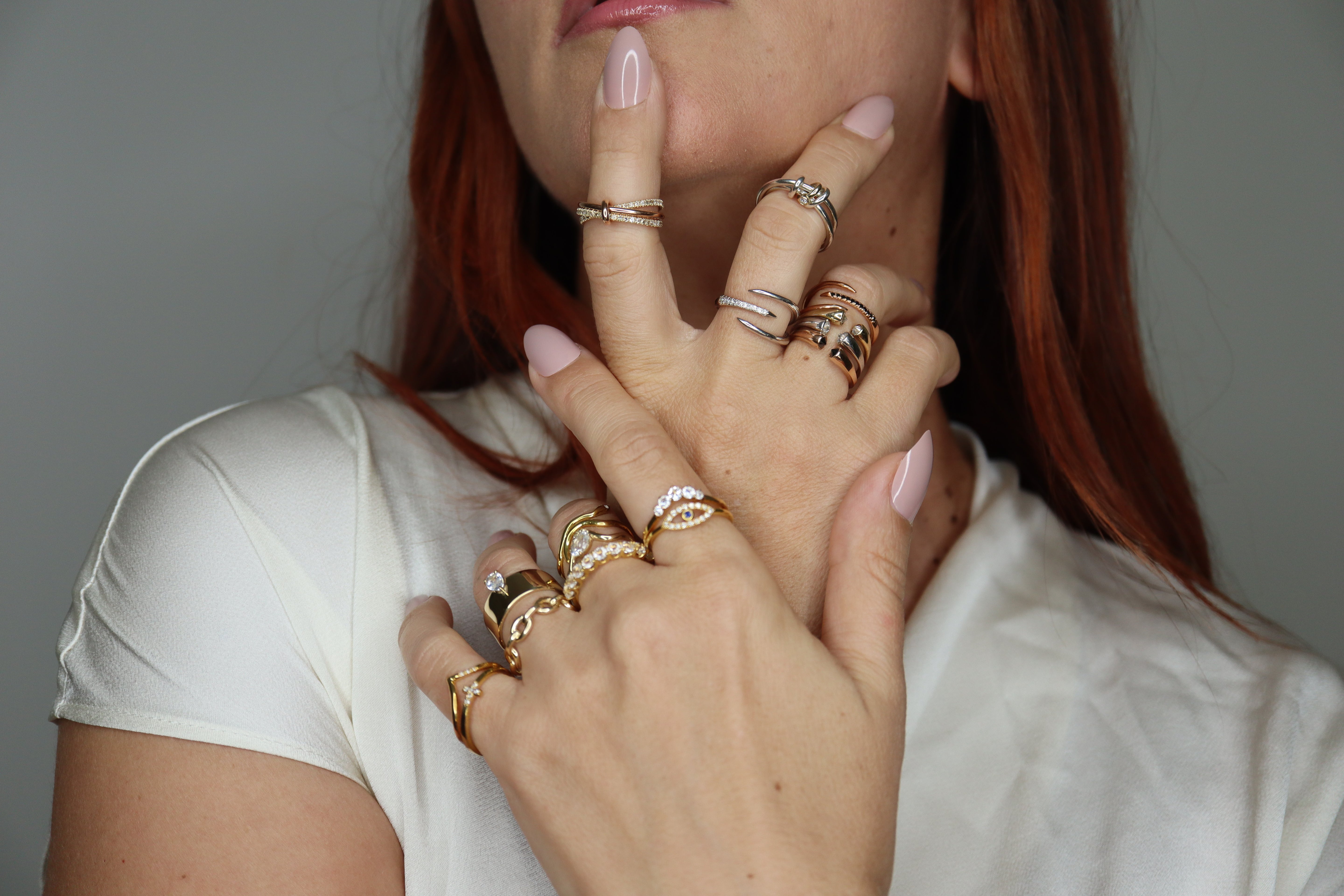





Diamond Pavé Rings: What to Know Before You Buy
Diamond pavé rings are rings where small diamonds are set closely together across a metal surface, held by tiny prongs or beads of gold, creating a continuous field of sparkle with minimal visible metal between stones. Pavé - from the French word for "paved" - describes this setting technique where, from a normal viewing distance, the band appears to be surfaced entirely in diamonds, catching and reflecting light from every angle as the ring moves on your hand.
Pavé diamond rings are among the most popular designs in fine jewelry because they deliver maximum sparkle per square millimeter. They also raise specific questions about durability, stone quality, cleaning, and long-term wear that this guide answers completely - including how pavé behaves differently in kinetic rings where the diamonds are set on moving components.
How Does Diamond Pavé Setting Work?
In a pavé setting, each diamond sits in a tiny seat drilled into the gold surface. The stone is held in place by small beads or micro-prongs raised from the surrounding metal and pushed over the edge of the diamond. When done correctly, the metal between stones is minimal - just enough to structurally secure each diamond while allowing maximum light to enter from the top and sides.
There are two primary pavé variations relevant to ring design:
Standard pavé uses diamonds typically ranging from 1mm to 2mm in diameter, set in one or more rows across the band surface. The prongs are visible under magnification but nearly invisible to the naked eye. This is the technique used across most of Antoanetta's diamond-accented designs.
Micro-pavé uses even smaller diamonds - often under 1mm - set with proportionally smaller prongs. The result is an even more seamless surface of light with virtually no visible metal. Micro-pavé requires exceptional precision from the stone setter because the tolerances are tighter and each diamond is more vulnerable to improper seating.
Both techniques demand skilled bench work. Each diamond must be individually seated, aligned with its neighbors, and secured by prongs that are strong enough to hold the stone permanently but low enough not to interfere with the smooth surface or catch on skin and fabric.
What Diamond Quality Matters Most in Pavé Settings?
Diamonds in pavé settings are evaluated differently than center-stone diamonds because they are viewed collectively rather than individually. The key quality factors shift in emphasis:
Color consistency matters more than individual color grade. In a pavé band, your eye perceives the overall color field. One slightly yellow diamond among otherwise white stones creates a visible inconsistency. Antoanetta selects pavé diamonds for color matching across the entire set - every stone in a given ring is drawn from the same color range to ensure a uniform appearance.
Clarity is less critical than in solitaires. Inclusions that would be visible in a 1-carat solitaire are invisible in a 1mm pavé diamond. The small size of pavé stones means that most inclusions cannot be seen without magnification. However, heavily included stones can appear cloudy or dark even at small sizes, so a baseline clarity standard is still important.
Cut quality drives the overall sparkle. Well-cut small diamonds reflect more light per stone, and the cumulative effect across a full pavé surface is dramatic. Poorly cut pavé diamonds look dull and flat. The difference between good and mediocre pavé is almost entirely a function of cut consistency across all the stones in the setting.
Total carat weight (TCW) represents the combined weight of all pavé diamonds in the ring. A design listed at "0.50ct total" means the sum of all the small stones equals half a carat. This metric helps compare the diamond content across different designs but does not describe any individual stone's size.
How Does Diamond Pavé Work on Kinetic Ring Designs?
Setting diamonds into components that move introduces engineering challenges that static pavé bands never face. On a kinetic ring, the pavé-set surface is in constant motion - links slide, bands rotate, and the diamonds experience micro-vibrations every time the moving components shift position.
The Fiamma demonstrates this: natural rubies are pavé-set along articulated rose gold links that spend their entire life sliding back and forth along the central band. Every stone must be set firmly enough to withstand continuous motion without loosening over years of daily wear. The Vortexa sets diamond pavé across interlocking rolling bands - the stones catch light from continuously changing angles as the bands orbit each other.
This is where Antoanetta's hand-setting process becomes critical. Each stone is individually secured by a skilled setter who tests the grip under magnification. Machine-set pavé - common in mass-produced jewelry - applies uniform pressure that may not account for microscopic variations in seat depth or stone shape. Hand-setting allows the jeweler to adjust each prong individually, ensuring every diamond is locked in place for the specific stresses of kinetic movement.
The visual reward is unique: pavé on a moving surface catches light from angles that a static band never reaches. As an articulated link rotates slightly, the diamonds flash from a new direction. As a rolling band orbits, the entire pavé surface sweeps through a full range of light angles in a single rotation. The sparkle is not just bright - it is kinetic, unpredictable, and constantly renewing.
What Is the Difference Between Full Eternity and Half Eternity Pavé?
A full eternity pavé band has diamonds set around the entire circumference of the ring. A half eternity band has diamonds across the top half (the visible portion when worn) with plain gold on the palm side.
Full eternity delivers sparkle from every angle - even if the ring rotates on your finger, diamonds remain visible. This is the more dramatic option and is particularly effective in rolling band kinetic designs where the band orbits and all surfaces take turns facing upward. The trade-off: full eternity bands are more difficult to resize because diamonds surround the entire circumference, leaving no plain gold section to cut and rejoin.
Half eternity concentrates the diamonds where they are most visible and leaves the palm side in plain polished gold. This approach is more practical for resizing, slightly less expensive (fewer diamonds), and often more comfortable since the smooth gold underside has no prong texture against your skin. For most wearers, the visual difference is minimal because the palm side of a ring is rarely seen.
Are Diamond Pavé Rings Durable Enough for Daily Wear?
Well-set pavé diamonds in solid 14k gold are durable enough for continuous daily wear. The 14k alloy's hardness provides strong prong retention - harder gold holds prongs in their set position more reliably than softer 18k or higher karat gold. Diamonds themselves are the hardest natural material (10 on the Mohs scale), so the stones will not scratch, chip, or wear down under normal use.
The most common durability concern with pavé is stone loss - a diamond coming loose from its setting. In quality pavé work on solid gold, this is rare. It is more common in plated or low-quality construction where soft base metal prongs weaken over time. In Antoanetta's rings, each prong is solid 14k gold, individually formed and checked for grip strength. On kinetic designs, the additional movement stress is accounted for during the setting process.
One practical note: pavé settings can accumulate lotion, soap residue, and skin oils between the stones and prongs, temporarily reducing sparkle. A simple soak in warm water with mild dish soap, followed by gentle brushing with a soft toothbrush, restores full brilliance. This maintenance takes five minutes and can be done weekly or whenever the sparkle looks subdued.
How Does Diamond Pavé Compare to Channel Setting?
Channel setting places diamonds in a groove (channel) cut into the metal, with the metal walls holding the stones in place rather than individual prongs. The result is a smooth, flush surface with no exposed prongs. Channel settings are extremely secure and snag-proof, making them popular for active lifestyles.
Pavé offers more sparkle than channel setting because the minimal metal between stones allows more light to enter each diamond from the sides. Channel settings sacrifice some brilliance for the added security of the metal walls. For kinetic rings where sparkle and movement are the primary appeal, pavé is the natural choice - the light performance is superior and the hand-setting process ensures adequate stone security for moving components.
How to Choose a Diamond Pavé Ring Design
For maximum sparkle on a kinetic ring: The Vortexa delivers the most concentrated pavé diamond experience - rolling eternity bands with continuous diamond surfaces that catch light from every orbital position.
For colored gemstone pavé: The Fiamma sets ruby pavé on moving links. The Trielle sets sapphire pavé on articulated rose gold links. Both add color to the kinetic sparkle experience. Read the ruby guide or read the sapphire guide for details on each gemstone.
For a pavé accent rather than full coverage: Several kinetic designs use a single diamond or small diamond cluster as an accent element within the moving structure. The Marque places a diamond accent on its 6mm moving-link band - sparkle integrated into the kinetic mechanism without covering the entire surface.
Frequently Asked Questions About Diamond Pavé Rings
Do pavé diamonds fall out easily?
In quality construction on solid 14k gold - no. Stone loss is associated with poor setting work, soft base metals, or worn plating. Hand-set pavé in solid gold maintains stone security for years of daily wear, including on kinetic ring components.
Can I shower with a pavé diamond ring?
Yes. Solid 14k gold and diamonds are unaffected by water, soap, and shampoo. Soap residue may temporarily dull sparkle between stones but is easily cleaned. Read the gold and water guide for complete details.
How do I clean pavé diamonds at home?
Soak in warm water with a drop of mild dish soap for 10-15 minutes. Gently brush with a very soft toothbrush, paying attention to the spaces between stones. Rinse under warm running water and pat dry. Repeat weekly or as needed.
Is pavé more expensive than a plain gold band?
Yes - the additional cost reflects the diamonds themselves plus the labor-intensive hand-setting process. The price difference depends on the number and quality of diamonds. Pavé accent designs (a few stones) add less cost than full eternity pavé (diamonds around the entire band).