



Anniversary Rings and Eternity Bands: Types, Milestone Gemstones, and How to Choose
How to Choose an Anniversary Ring or Eternity Band for a Milestone
Choosing an anniversary ring or eternity band comes down to whether you want a piece that stacks with your existing wedding set or a standalone design with its own identity, which gemstone carries the most personal meaning, and whether the ring marks a relationship milestone or a personal one. An anniversary ring is not a replacement for your wedding band. It is an addition. A new chapter added to the story your left hand tells, a piece that says: we made it through another year, another milestone, and the journey keeps getting better.
Eternity bands, with their continuous circle of gemstones, are the most traditional anniversary ring choice. But the category has expanded far beyond the classic diamond eternity band. Kinetic designs, colored gemstones, wide bands, and mixed metals all serve as milestone rings that reflect your personal style rather than defaulting to what tradition dictates.
What Is an Eternity Band?
An eternity band is a ring with gemstones set continuously around the entire circumference, creating an unbroken circle of stones. The name refers to the symbolism: a circle with no beginning and no end, representing enduring love or commitment.
Full eternity: Stones set all the way around the band with no gaps. The visual effect is consistent sparkle from every angle. The practical consideration is that full eternity bands are harder to resize because the continuous settings leave no section of plain metal where a jeweler can cut. Read the resizing guide for details.
Half eternity: Stones set across the top half of the band (the visible portion when worn), with plain gold on the bottom half. This design is easier to resize, more comfortable against adjacent fingers, and less expensive than full eternity while delivering nearly identical visual impact from the top view.
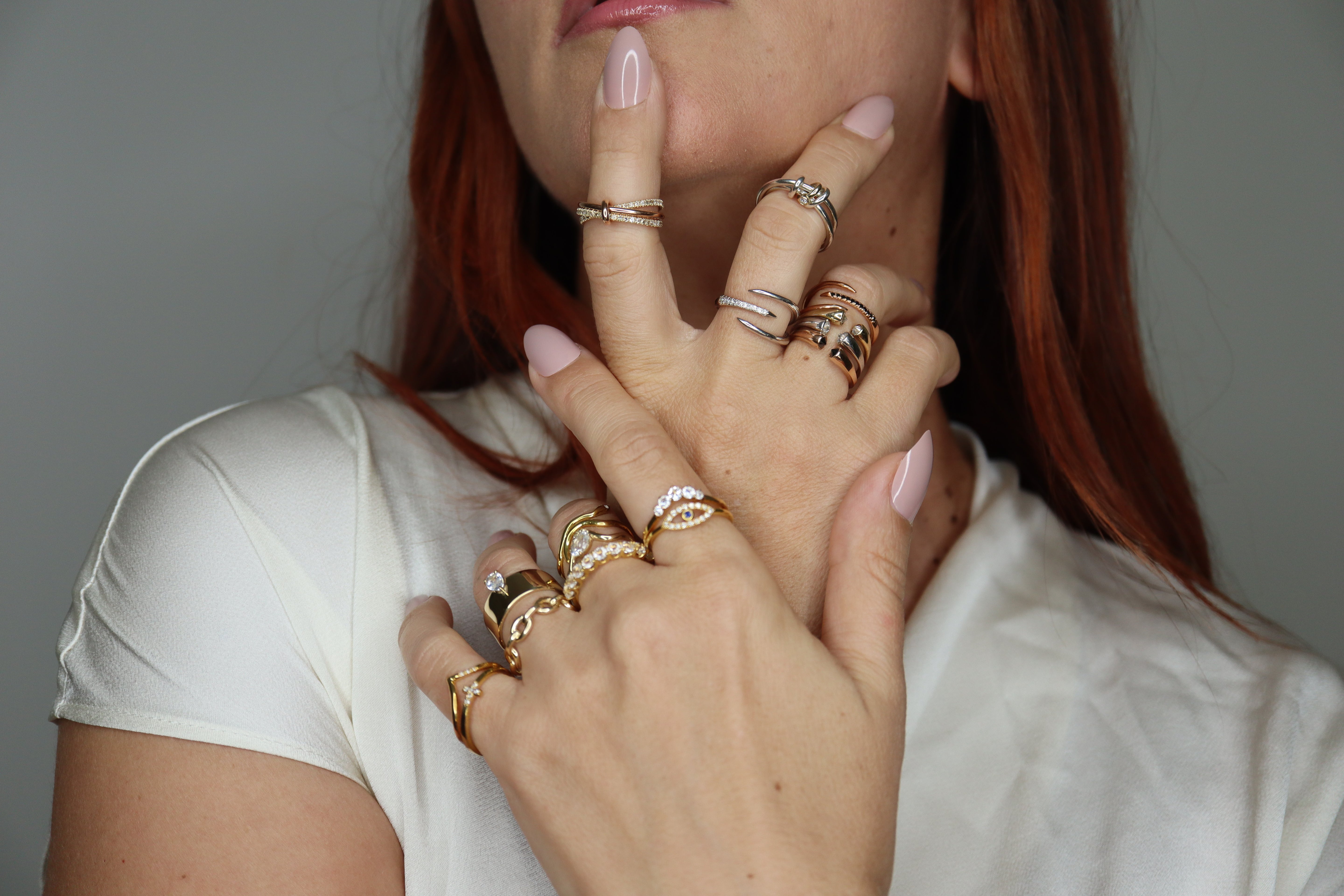
The Vortexa reimagines the eternity concept entirely, using diamond pavé on interlocking rolling bands in two gold colors. As the bands rotate, the diamond lines shift position, creating an eternity effect that moves rather than sits static. This kinetic interpretation of the eternity band is distinctly different from anything available in traditional jewelry.
Which Anniversary Ring Matches Each Milestone Year?
Traditional anniversary gift guides assign specific materials to each year. While these are guidelines rather than rules, they provide useful starting points:
1st anniversary (gold): A solid 14k gold band, whether a slim stacking ring or a kinetic design, celebrates the first year with the material that will last through every anniversary that follows.
5th anniversary (sapphire): A sapphire-set ring in solid gold marks five years with one of the most durable and vibrant colored gemstones available. The Trielle with sapphire makes an exceptional five-year piece.
10th anniversary (diamond): The decade mark calls for diamond, and a diamond pavé kinetic ring or eternity band combines traditional symbolism with Antoanetta's kinetic signature.
15th anniversary (ruby): Ruby's rich red symbolizes deep, enduring love. The Seraphina with ruby and diamond pavé rolling bands, or the Fiamma with ruby-set moving links, deliver both color and movement.
20th anniversary (emerald): Emerald represents renewal and growth. Kinetic designs with emerald accents mark two decades with a stone that feels both timeless and fresh.
25th anniversary (silver jubilee/major gemstone): A quarter century deserves something significant. A multi-stone kinetic ring or a diamond eternity band with serious carat weight reflects the depth of 25 years together.
Should You Choose a Traditional Eternity Band or a Kinetic Anniversary Ring?
The decision comes down to what kind of piece feels more meaningful to you:
Choose a traditional eternity band if you want a ring that stacks seamlessly against your engagement ring and wedding band, creating a flush three-ring set on the left hand. Eternity bands are designed for this purpose, and their slim, flat profile sits cleanly beside other rings without gaps or tilting.
Choose a kinetic anniversary ring if you want a piece with its own identity - something that stands alone as a distinct ring rather than blending into an existing set. Kinetic designs are typically worn on a different finger or the other hand because their moving components create a profile that does not stack flush against traditional rings. This independence makes them feel more like a fresh addition to your collection than an extension of what is already there.
Choose both over time. Many women add an eternity band to their left hand at one anniversary and a kinetic piece to their right hand at the next. Building the collection across milestones turns your jewelry into a timeline of your relationship.
Can You Buy an Anniversary Ring for Yourself?
Anniversary rings do not need to come from a partner. Buying yourself an anniversary ring to mark a personal milestone - a year of sobriety, a year since starting your business, a year in a new city - is a growing tradition that carries its own significance. The right-hand ring guide covers the self-purchase mindset in detail.
The ring marks time, and time is yours to celebrate regardless of relationship status.
Which Colored Gemstones Work Best for Anniversary Rings?
Diamond eternity bands are the default, but colored gemstones add personal meaning that colorless diamonds do not. Each stone carries different symbolism and creates a different visual effect:
Ruby for passion and enduring love. Sapphire for loyalty and trust. Morganite for tenderness and compassion. Aquamarine for clarity and calm. Emerald for growth and renewal.
Choosing a gemstone based on personal significance rather than convention makes the ring more meaningful and more unique. Read the colored gemstone guide for detailed profiles of each stone.
Frequently Asked Questions About Anniversary Rings and Eternity Bands
Which finger does an anniversary ring go on?
If it is an eternity band meant to stack with your engagement and wedding rings, it typically goes on the left ring finger. If it is a standalone kinetic ring or a self-purchased milestone piece, any finger on either hand works. There are no rules beyond what feels right to you.
Can I wear an eternity band without an engagement ring?
Absolutely. Many women wear eternity bands as standalone rings, stacking pieces, or right-hand rings without any connection to an engagement ring. The design stands on its own.
How do I size an eternity band if it is hard to resize?
Get your size right before ordering. The sizing guide is essential reading for eternity bands because the continuous gemstone settings limit resizing options. Measure carefully and consider the comfort fit guide if the band is wider than 4mm.