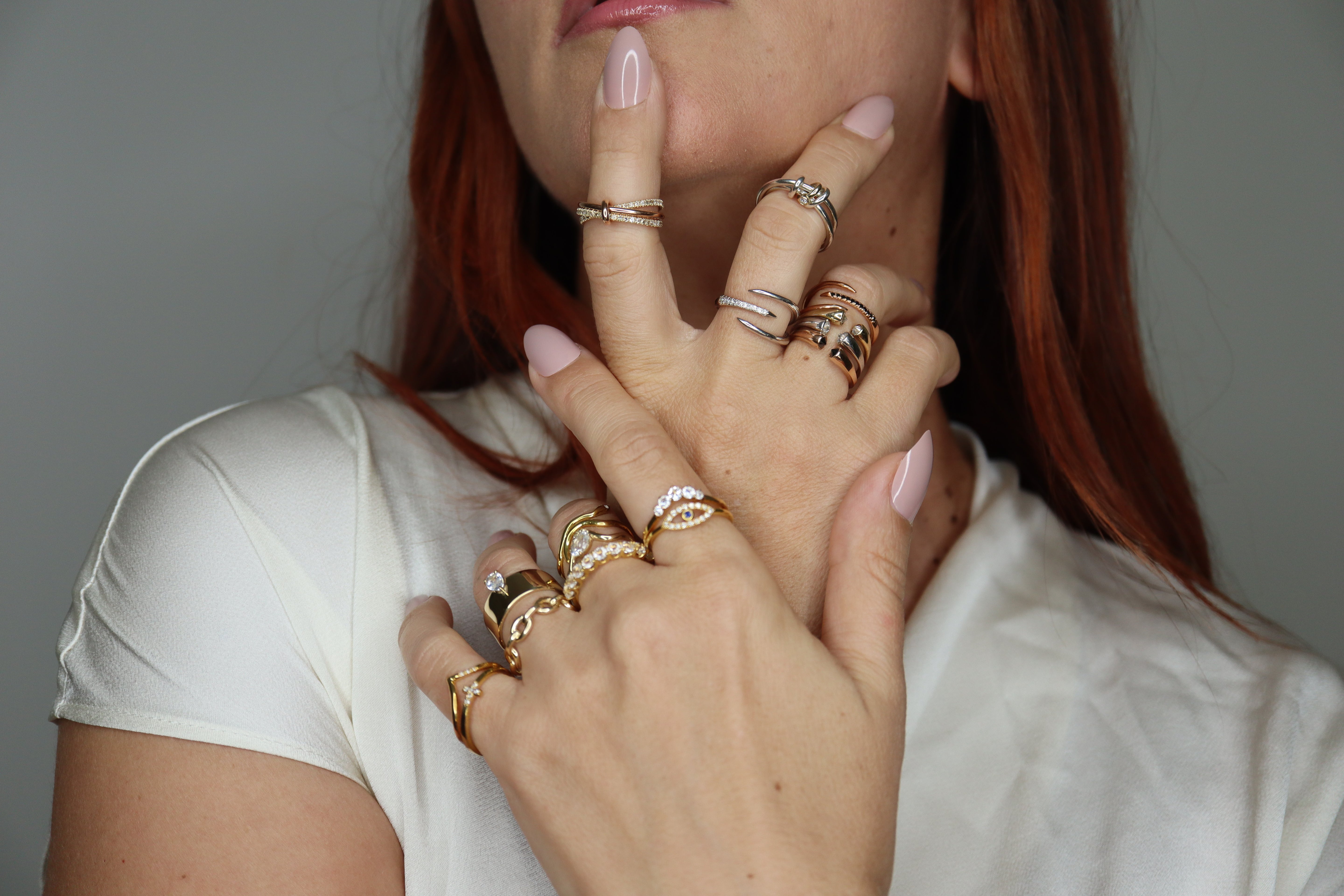





Ring Size Conversion Chart: US, UK, EU & MM
Use this ring size conversion chart to convert between US, UK, EU, Japanese, inside diameter, and inside circumference measurements. US and Canada use numbered ring sizes, the UK and Australia use letter sizes, and most European ring sizes are based on the ring’s inner circumference in millimeters.
If you already know your size in one system, use the chart below to find the closest match in another system. For example, a US size 6 is approximately a UK size L and a European size 51.5 to 52, while a US size 7 is approximately a UK size N and a European size 54.
Antoanetta uses US ring sizing as the standard. If you are ordering a made-to-order ring and only know your UK, EU, Japanese, diameter, or circumference measurement, this chart will help you find the closest US size before placing your order.
Most Common US, UK, and EU Ring Size Conversions
If you need a quick conversion, start with the most commonly searched ring sizes below. These are approximate equivalents because each sizing system uses slightly different increments.
| US / Canada | UK / Australia | Europe | Inside Diameter | Inside Circumference |
|---|---|---|---|---|
| US 5 | UK J | EU 49 | 15.7 mm | 49.3 mm |
| US 6 | UK L | EU 51.5 to 52 | 16.5 mm | 51.8 mm |
| US 7 | UK N | EU 54 | 17.3 mm | 54.4 mm |
| US 8 | UK P | EU 57 | 18.2 mm | 57.0 mm |
| US 9 | UK R | EU 59 | 19.0 mm | 59.5 mm |
| US 10 | UK T | EU 62 | 19.8 mm | 62.1 mm |
For the most accurate fit, compare both the size label and the millimeter measurement. If your measurement falls between two sizes, the better choice depends on the ring width, band profile, and how snugly you prefer your ring to fit.
Full Ring Size Conversion Chart: US, UK, EU, Japan, Diameter & Circumference
Use the full chart below to convert between US, UK, European, Japanese, inside diameter, and inside circumference ring sizes. If you know your size in one system, find it in that column and read across the row to find the closest equivalent in another system.
| US / Canada | UK / Australia | Europe | Japan | Inside Diameter | Inside Circumference |
|---|---|---|---|---|---|
| 3 | F | 44 | 4 | 14.0 mm | 44.0 mm |
| 3.5 | G | 45.5 | 5 | 14.4 mm | 45.5 mm |
| 4 | H | 47 | 7 | 14.9 mm | 46.8 mm |
| 4.5 | I | 48 | 8 | 15.3 mm | 48.0 mm |
| 5 | J | 49 | 9 | 15.7 mm | 49.3 mm |
| 5.5 | K | 50.5 | 10 | 16.1 mm | 50.6 mm |
| 6 | L | 51.5 | 12 | 16.5 mm | 51.8 mm |
| 6.5 | M | 53 | 13 | 16.9 mm | 53.1 mm |
| 7 | N | 54 | 14 | 17.3 mm | 54.4 mm |
| 7.5 | O | 55.5 | 15 | 17.7 mm | 55.7 mm |
| 8 | P | 57 | 16 | 18.2 mm | 57.0 mm |
| 8.5 | Q | 58 | 17 | 18.6 mm | 58.3 mm |
| 9 | R | 59 | 18 | 19.0 mm | 59.5 mm |
| 9.5 | S | 61 | 19 | 19.4 mm | 60.8 mm |
| 10 | T | 62 | 21 | 19.8 mm | 62.1 mm |
| 10.5 | U | 63.5 | 22 | 20.2 mm | 63.4 mm |
| 11 | V | 64.5 | 23 | 20.6 mm | 64.6 mm |
| 11.5 | W | 66 | 24 | 21.0 mm | 65.9 mm |
| 12 | X | 67 | 25 | 21.4 mm | 67.2 mm |
For the most reliable fit, use the millimeter measurements whenever possible. Diameter and circumference are physical measurements, while US, UK, EU, and Japanese sizes are labels that approximate those measurements.
US to UK Ring Size Conversion
To convert a US ring size to a UK size, find your US size in the chart and read across to the UK / Australia column. US ring sizes use numbers, while UK ring sizes use letters, so the same number does not carry over between systems.
For example, a US size 6 is approximately a UK size L, a US size 7 is approximately a UK size N, and a US size 8 is approximately a UK size P.
| US ring size | Closest UK ring size |
|---|---|
| US 5 | UK J |
| US 6 | UK L |
| US 7 | UK N |
| US 8 | UK P |
| US 9 | UK R |
| US 10 | UK T |
To convert a UK ring size to a US size, start with the UK letter size and read back to the US / Canada column in the full chart. If your UK size falls between two US sizes, choose based on the ring style: narrow bands can often use the closer size, while wide bands may feel better with the larger option.
European Ring Size to US Conversion
European ring sizes are usually based on the ring’s inside circumference in millimeters. That means a European size 52 is close to a 52 mm inner circumference, which converts to approximately a US size 6.
To convert a European ring size to a US size, find the EU size in the chart and read across to the US / Canada column. For example, EU 49 is approximately US 5, EU 54 is approximately US 7, and EU 57 is approximately US 8.
| European ring size | Closest US ring size | Inside circumference |
|---|---|---|
| EU 49 | US 5 | 49.3 mm |
| EU 51.5 to 52 | US 6 | 51.8 mm |
| EU 54 | US 7 | 54.4 mm |
| EU 57 | US 8 | 57.0 mm |
| EU 59 | US 9 | 59.5 mm |
| EU 62 | US 10 | 62.1 mm |
If your European size falls between two US sizes, use the millimeter measurement as the deciding factor. For made-to-order rings, the inside circumference or inside diameter is often more useful than the regional size label alone.
How Are Ring Sizes Measured in Different Countries?
All ring sizing systems describe the same physical fit: the ring’s inside diameter or inside circumference. The difference is how each country labels those measurements. That is why a US size 6, a UK size L, and a European size 51.5 to 52 can describe nearly the same ring size.
| Region | Sizing system | How it works |
|---|---|---|
| US and Canada | Number sizes | Uses whole and half sizes, such as 5, 5.5, 6, and 6.5 |
| UK, Australia, and South Africa | Letter sizes | Uses letters, such as J, K, L, M, N, and P |
| Europe | Circumference-based sizes | Often uses the ring’s inside circumference in millimeters, such as 52 mm or 54 mm |
| Japan | Number sizes | Uses a numbered scale that does not match US numbering exactly |
Because each system uses different labels and increments, ring size conversions are approximate. For the most accurate fit, use the inside diameter or inside circumference in millimeters whenever possible, especially for made-to-order rings.
How to Use the Ring Size Conversion Chart
If you already know your ring size in one system, find that size in the chart and read across the same row to see the closest equivalent in the other systems. For example, if you know you are a US size 7, the chart shows the closest match as UK N, EU 54, Japan 14, 17.3 mm inside diameter, and 54.4 mm inside circumference.
If you measured your finger in millimeters, use the inside circumference or inside diameter columns instead of guessing from a country-based size label. Circumference is the measurement around your finger, while diameter is the measurement across the inside of a ring that already fits.
If you used the paper strip method to measure your ring size at home, match your millimeter circumference to the closest number in the rightmost column, then read left to find your US ring size.
If your measurement falls between two sizes, consider the ring style before choosing. A narrow band can usually use the closest size, while a wider band may feel better if you round up slightly. For rings that are 5 mm or wider, check the wide band sizing guide before ordering.
Antoanetta rings are made in US sizes. If you are unsure after converting your size, contact the designer with your millimeter measurement before ordering so the final fit can be checked against the specific ring design.
Are Ring Size Conversions Exact?
Ring size conversions are close approximations, not perfect one-to-one matches. US, UK, European, and Japanese ring sizing systems use different labels and slightly different increments, so a converted size may be off by a small amount.
In most cases, the difference is minor enough that the closest converted size will fit comfortably. But if you are between sizes, ordering a wide band, or choosing a made-to-order ring, it is better to rely on the inside diameter or inside circumference in millimeters instead of the regional size label alone.
For example, a US size 6 is close to a UK size L and a European size 51.5 to 52, but the millimeter measurement gives the clearest fit reference. If you can measure a ring that already fits, use its inside diameter. If you are measuring your finger, use the inside circumference measurement.
If you are unsure after converting your size, choose the closest size based on the ring style. Narrow bands are more forgiving, while wide bands and kinetic rings may need extra fit consideration.
When Should You Adjust Your Ring Size?
A converted ring size is a strong starting point, but the final fit can change depending on the ring’s width, interior profile, and design. Before ordering, consider whether the ring is narrow, wide, comfort fit, standard fit, or kinetic.
Wide bands may need a larger size
Wide bands usually feel tighter than narrow rings in the same size because they cover more surface area on the finger. If you are ordering a ring that is 5 mm or wider, you may feel more comfortable sizing up by a half size.
This is especially important for wide gold band rings or substantial designs like the Marque. For more detailed guidance, read the wide band sizing guide.
Comfort fit rings can feel slightly roomier
A comfort fit ring has a softly rounded interior, so it may slide over the knuckle more easily and feel slightly roomier once it is on the finger. A standard fit ring has a flatter interior and may feel more exact at the same size.
If you are switching between these profiles, read the comfort fit vs standard fit guide before choosing your final size.
Kinetic rings need design-specific fit guidance
Kinetic and articulated rings can have moving links, rolling bands, or layered components that affect how the ring feels during wear. The correct size depends not only on the finger measurement, but also on the way the design moves on the hand.
If you are choosing one of Antoanetta’s gold kinetic rings, send your US size, converted size, or millimeter measurement before ordering so the fit can be checked against the specific design.
If you are between sizes, consider the ring style
If your measurement falls between two sizes, a narrow ring may fit well in the closer size. For a wide band, comfort-focused ring, or kinetic design, the larger option may feel better. When in doubt, use your millimeter measurement and ask for sizing guidance before placing a made-to-order ring.
Frequently Asked Questions About Ring Size Conversion
What is a US size 6 ring in UK and EU sizing?
A US size 6 ring is approximately a UK size L and a European size 51.5 to 52. It has an inside diameter of about 16.5 mm and an inside circumference of about 51.8 mm.
What is a UK size N ring in US sizing?
A UK size N ring is approximately a US size 7. It is also close to a European size 54, with an inside diameter of about 17.3 mm and an inside circumference of about 54.4 mm.
What is a European size 52 ring in US sizing?
A European size 52 ring is approximately a US size 6. European sizes are usually based on inside circumference in millimeters, so an EU 52 ring has an inside circumference close to 52 mm.
Are US and UK ring sizes the same?
No. US ring sizes use numbers, while UK ring sizes use letters. For example, a US size 6 is close to a UK size L, and a US size 7 is close to a UK size N.
Are European ring sizes the same as millimeters?
European ring sizes are usually based on inside circumference in millimeters. For example, an EU size 54 is close to a 54 mm inside circumference. Small rounding differences can exist, so use the full chart when converting.
What is the average ring size for women?
In the US, the average women’s ring size is approximately size 6, though sizes 5 through 7 are commonly ordered. Finger size varies, so it is always better to measure the exact finger instead of guessing from an average.
Should I size up for a wide band?
Often, yes. Wide bands can feel tighter than narrow rings because they cover more surface area on the finger. If the ring is 5 mm or wider, many people prefer to size up by a half size for comfort.
What should I do if I am between two ring sizes?
If you are between two sizes, choose based on the ring style. A narrow band may fit well in the closer size, while a wide band or kinetic ring may feel better in the larger size. When possible, use your inside diameter or circumference measurement in millimeters.
Can Antoanetta make non-standard ring sizes?
Because Antoanetta rings are made to order, non-standard sizes may be available for certain designs. If your converted size is unusual or you are unsure which size to choose, contact the designer with your millimeter measurement and preferred ring design.
Choosing the Right Ring Size Before You Order
A ring size conversion chart gives you the closest match between sizing systems, but the best fit also depends on the ring’s width, shape, and how you like a ring to feel on your finger. Before ordering, compare your converted size with your millimeter measurement and consider the specific design you want.
For narrow bands, the closest converted size is often enough. For wide gold band rings, kinetic rings, or rings with a substantial profile, a half-size adjustment may feel better.
Antoanetta uses US sizing for all made-to-order rings. If you are shopping for 14k gold rings and only know your UK, EU, Japanese, diameter, or circumference measurement, use the chart above to find your closest US size. If you are still unsure, contact the designer with your millimeter measurement and preferred ring design before placing your order.
Related Ring Sizing Guides
For the most accurate fit, use the conversion chart together with the right measuring method and fit adjustment for your chosen ring style.
These guides are especially useful when ordering a made-to-order ring, choosing a wide band, or converting from an international size to Antoanetta’s US sizing standard.